
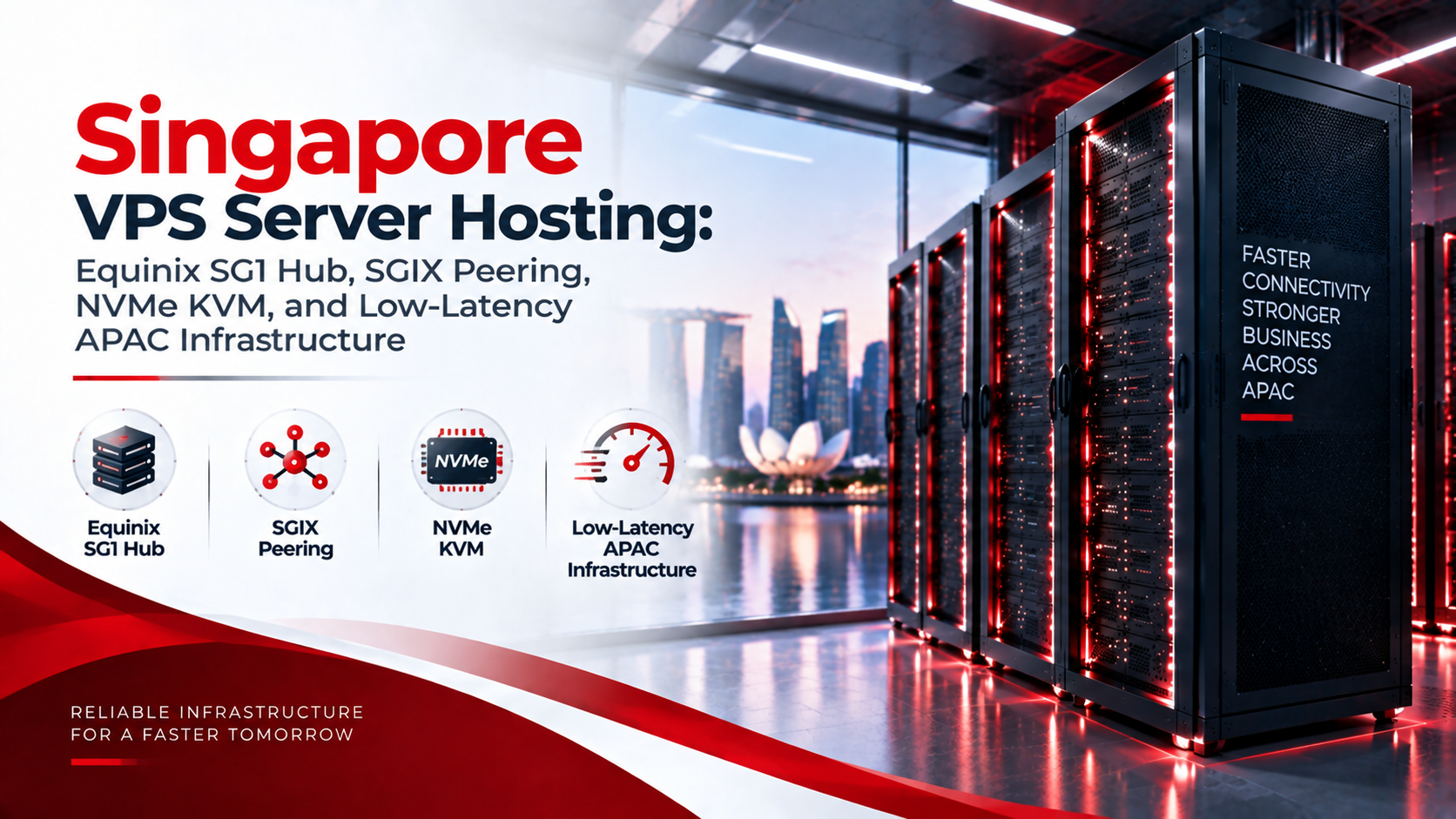
Singapore VPS hosting delivers dedicated KVM compute resources housed in tier-3 Singapore data centers, interconnected directly via SGIX and Equinix SG. Engineered for startups, digital agencies, and eCommerce portals targeting Southeast Asian audiences, it provides ultra-fast NVMe storage, dedicated vCPU allocations, and sub-15ms regional response times.
- Kernel-Level KVM Virtualization: Guaranteed hardware resources with zero overselling ensure consistent application responsiveness.
- Enterprise NVMe Storage: Rapid disk I/O accelerates database-driven web platforms, Node.js runtimes, and PHP execution.
- Strategic Regional Peering: Direct interconnects provide lightning-fast routing across Singapore, Malaysia, and Indonesia.
- Scalable Cloud Provisioning: Upgrade vCPU, memory, and storage instantly as user traffic and processing demands increase.
Targeting users across Southeast Asia demands a low-latency cloud hosting footprint in Singapore’s world-class data centers. Our Singapore KVM VPS servers combine the dedicated performance and root control of private servers with the cost-efficiency and instant scalability of cloud virtualization. Backed by high-speed NVMe arrays and resilient network routing, your applications benefit from responsive load times and high availability. For organizations scaling high-throughput compute workloads, our Singapore VPS server hosting solutions provides dedicated unmetered performance and enterprise hardware isolation.
Organizations operating ecommerce platforms, financial technology exchanges, gaming backends, and regional SaaS portals face unique network geography challenges. Routing traffic through distant European or North American hosts introduces round-trip delays exceeding 180 milliseconds, degrading customer interaction and hurting search engine rankings. Choosing a local vps hosting solution located at Equinix SG1 or Global Switch Tai Seng establishes baseline ping times under 15 milliseconds across major ASEAN population centers. When selecting a server administration interface, review our comprehensive Plesk vs cPanel control panel guide.
Hardware virtualization architecture distinguishes true enterprise hosting from legacy container platforms. Kernel-based virtual machines provide total kernel independence, hardware virtualization flags, and dedicated resource scheduling. Unlike shared environments where noisy neighbors deplete available compute cycles, dedicated KVM virtualization guarantees compute, memory, and storage allocations directly from high-density physical host nodes.
Hardware Architecture, AMD EPYC Compute, and DDR5 Memory Allocation
Modern workloads demand scalable processing density capable of handling volatile traffic spikes without thermal throttling. Our Singapore hypervisor fleet runs on enterprise AMD EPYC 9004 series processors with base frequencies of 3.1 GHz and boost capability reaching 4.1 GHz across 64 cores per socket. Host nodes operate in dual-socket configurations, providing 128 physical processing cores and 256 threads to distribute guest virtual machines evenly.
Memory subsystems utilize 4800 MHz DDR5 registered ECC modules configured across twelve memory channels per socket. Error-Correcting Code architecture detects and remediates single-bit memory faults in real time, preventing unexpected kernel panics and application crashes during mission-critical transactions. We reject memory overcommitment or dynamic memory ballooning algorithms. When your virtual machine provisions 16 GB or 32 GB of RAM, that memory space is locked into physical hypervisor memory via transparent hugepages.
Dedicated compute cores ensure reliable execution loops for intensive databases such as PostgreSQL, MongoDB, and Redis caching layers. Because hypervisor schedulers enforce strict CPU affinity and vCPU pinning, execution latency remains deterministic under heavy transactional loads. Whether managing clustered database shards or rendering dynamic application components, hardware allocations perform with near bare-metal consistency.
PCIe Gen4 NVMe Storage Subsystems and FIO I/O Benchmarking
Storage throughput directly dictates application responsiveness, database write transactions, and compile times. Traditional SATA and SAS solid-state drives cap out at 550 MB/s per drive over legacy controller buses. Our Singapore infrastructure uses enterprise U.2 PCIe Gen4 NVMe solid-state arrays arranged in hardware RAID-10 topologies with battery-backed write cache.
This storage architecture delivers continuous sequential read velocities exceeding 7,000 MB/s and sequential write performance above 5,200 MB/s. Random 4K read throughput consistently sustains 850,000 IOPS per array, ensuring that heavy transactional workloads do not face disk queue bottlenecks. Below is the standard Flexible I/O Tester benchmark configuration used to validate storage volume performance upon initial provisioning:
Sub-millisecond write latency protects transactional databases against journaling lockups during sudden concurrency surges. Automated daily block-level snapshots take place outside guest operating hours, allowing granular recovery to exact point-in-time states without performance degradation.
Singapore Network Architecture, Equinix Hubs, and SGIX Peering
Network connectivity serves as the decisive factor for Southeast Asian operations. Our Singapore physical nodes terminate in Tier-3 carrier-neutral facilities including Equinix SG1 (Ayer Rajah) and Global Switch (Tai Seng). These datacenters maintain direct cross-connects to the Singapore Internet Exchange (SGIX) and the Equinix Internet Exchange, establishing local peering agreements with SingTel, StarHub, M1, ViewQwest, and regional telecoms.
By routing domestic Singapore and regional ASEAN traffic through local exchange fabrics rather than international transit paths, packet hops drop significantly. International traffic routes across diversified Tier-1 upstream carriers including Lumen, Telstra, Tata Communications, NTT, and PCCW Global. Multiple redundant 100 Gbps fiber links deliver automated BGP path failover within 40 milliseconds if an individual subsea cable segment suffers a fiber cut.
| Destination City | Upstream Transit / Exchange | Average Round-Trip Latency | Packet Loss Ratio |
|---|---|---|---|
| Singapore Domestic | SGIX / Direct Fiber | 1.2 – 2.8 ms | < 0.001% |
| Kuala Lumpur, Malaysia | Terrestrial Cross-Border Fiber | 6.5 – 9.2 ms | < 0.01% |
| Jakarta, Indonesia | Subsea Direct Cable (B2JS) | 10.4 – 13.8 ms | < 0.01% |
| Bangkok, Thailand | NTT / Telstra Transit | 22.1 – 26.5 ms | < 0.01% |
| Manila, Philippines | Tata / PLDT Transit | 34.2 – 38.9 ms | < 0.02% |
| Sydney, Australia | Southern Cross / Indigo-Central | 88.5 – 94.0 ms | < 0.02% |
Linux Kernel Network Tuning for High-Concurrency Web Traffic
Default Linux kernel networking settings target modest desktop setups rather than high-throughput server appliances. When handling tens of thousands of concurrent client sessions, operating systems quickly exhaust default connection queues and socket memory buffers. Systems administrators must tune `/etc/sysctl.conf` parameters to accommodate high socket density and maximize bandwidth utilization across long-haul paths:
Deploying the BBR (Bottleneck Bandwidth and RTT) congestion control algorithm ensures that packets flow at line rate across trans-oceanic routes without throughput collapse during transient queue congestion. Socket reuse mechanisms prevent TCP TIME_WAIT accumulation during heavy API traffic bursts.
Production Database Optimization and Memory Buffer Pool Tuning
Relational database management systems like PostgreSQL and MySQL InnoDB represent the core computational workload for most enterprise web applications. Because NVMe storage arrays provide rapid access times, tuning database configuration parameters to match hardware limits unlocks significant performance gains. Below are key parameters for optimizing PostgreSQL on our Singapore VPS instances: To achieve balanced multi-instance agility and cost efficiency, pair your deployment with Singapore dedicated server hosting infrastructure featuring high-speed NVMe storage arrays.
Configuring a low random_page_cost value of 1.1 instructs the database query planner that reading non-contiguous data blocks incurs virtually no mechanical seek penalty on NVMe storage. As a result, the optimizer favors index scans over expensive sequential table scans, reducing CPU cycles and accelerating complex analytical queries.
Infrastructure Observability, Prometheus Exporters, and Systemd Isolation
Maintaining high service availability requires continuous visibility into virtual machine telemetry. Every production server should deploy lightweight Prometheus node exporters running under systemd with strict cgroup resource constraints. This configuration prevents monitoring agents from consuming excessive compute resources while delivering metrics to central dashboards:
By defining explicit memory ceilings and CPU quotas in systemd service definitions, administrators ensure that unexpected memory leaks inside background services are killed before they endanger critical web or database processes.
Hardware Profiles and Resource Allocation Matrix
Each production workload presents distinct operational requirements. Selecting appropriate compute, memory, and NVMe disk quotas prevents resource starvation while eliminating excessive infrastructure expenditures. Below is the standard technical allocation matrix available for deployment in our Singapore facility:
| Plan Tier | Dedicated vCPU | DDR5 ECC RAM | PCIe Gen4 NVMe | Port Speed & Transfer |
|---|---|---|---|---|
| SG-Standard-01 | 2 vCPU Cores | 4 GB DDR5 | 60 GB NVMe RAID-10 | 1 Gbps Unmetered (Fair Share) |
| SG-Business-02 | 4 vCPU Cores | 8 GB DDR5 | 120 GB NVMe RAID-10 | 1 Gbps Port / 5 TB Outbound |
| SG-Enterprise-03 | 8 vCPU Cores | 16 GB DDR5 | 250 GB NVMe RAID-10 | 1 Gbps Port / 10 TB Outbound |
| SG-HighDensity-04 | 16 vCPU Cores | 32 GB DDR5 | 500 GB NVMe RAID-10 | 2.5 Gbps Port / 20 TB Outbound |
For organizations requiring unshared physical hardware, custom hybrid deployments allow linking private instances directly to a dedicated server node inside the same Singapore cluster over private VLAN switches.
Security Hardening, Stateful Packet Filtering, and In-Line Mitigation
Public-facing cloud instances encounter relentless scanning, credential brute-forcing, and distributed denial of service floods. Defending application endpoints requires configuring kernel-level packet inspection before malicious packets penetrate user-space daemons. We implement stateful `nftables` configurations paired with automated volumetric scrubbing at our edge routers:
Upstream network scrubbing centers analyze incoming traffic flows using automated heuristics to absorb volumetric SYN, UDP, and NTP amplification floods up to 1.2 Tbps. Clean traffic routes straight to your instance, keeping services accessible during massive regional attacks without rate-limiting legitimate end-users.
Management Interface, Out-of-Band noVNC, and Provisioning
Operational control represents a critical requirement for production environments. Every virtual machine provisioned in Singapore includes web-based dashboard management, allowing reboot, hard shutdown, recovery media attachment, and real-time resource telemetry. If an administrative configuration error breaks SSH connectivity, an out-of-band HTML5 noVNC terminal provides direct graphical console access to the virtual frame buffer.
Standard operating system images include Ubuntu 22.04 LTS, Ubuntu 24.04 LTS, Debian 12 Bookworm, AlmaLinux 9, Rocky Linux 9, and Windows Server 2022 Datacenter Edition. Alternatively, engineers can upload custom ISO images directly via URL, initiating custom kernel parameters, encrypted partitioning schemes, or specialized appliance configurations with full console visibility.
Deploying alongside standard web hosting environments enables smooth staging, development, and production workflows across your entire infrastructure portfolio.
Frequently Asked Questions
Q:
What makes Singapore an ideal datacenter location for virtual private servers?
Q:
How does KVM virtualization prevent resource contention between instances?
Q:
What level of root access and administrative control is provided?
Q:
How are data backups and point-in-time recovery handled?
Q:
Can I scale CPU, RAM, and NVMe disk quotas as my traffic increases?
Infrastructure Decision Framework: Choosing Your Deployment
Balancing low latency transit, dedicated hardware isolation, and predictable operating costs ensures long-term performance stability for enterprise applications.
Deploy high-performance scalable VPS hosting solutions equipped with enterprise NVMe storage arrays, redundant network uplinks, and 24/7 expert engineering support from Onlive Infotech.
For streamlined domain management and server configuration across multi-tenant environments, refer to our comprehensive Plesk vs cPanel hosting control panel guide.
•

✓
