
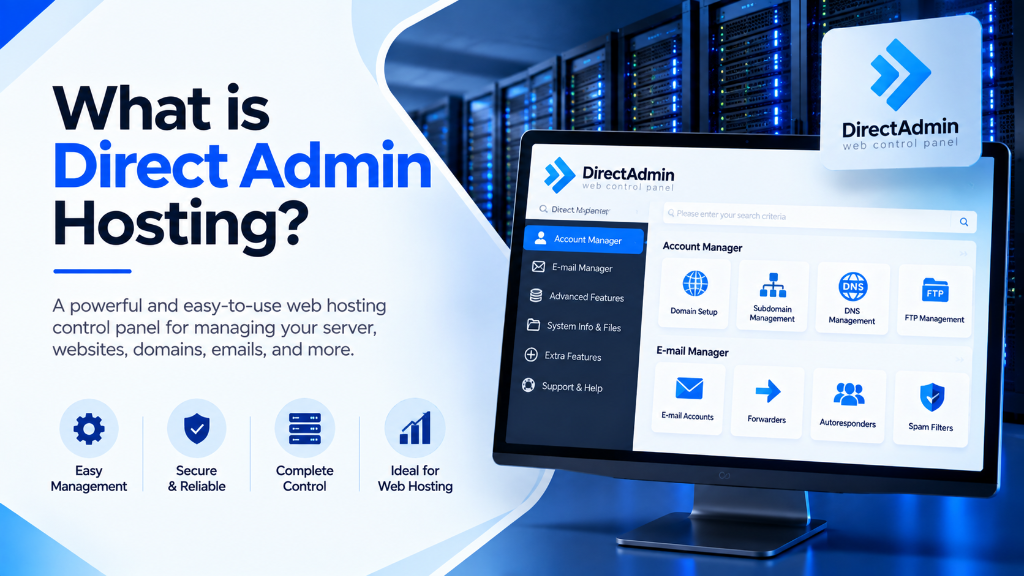
In modern web hosting and multi-tenant systems administration, control panel efficiency directly dictates server resource utilization, operating costs, and application responsiveness. While legacy management panels have grown increasingly resource-heavy and financially burdensome due to predatory per-account licensing models, enterprise systems architects have embraced DirectAdmin as a lean, blazingly fast, and highly customizable alternative. Deploying uncalibrated control panel software on raw cloud compute frequently results in memory bloat, sub-optimal web server worker configurations, and database query contention under traffic spikes. Mastering disciplined direct admin hosting transforms standard virtualized compute into an enterprise-grade web delivery platform. Powered by CustomBuild 2.0, native OpenLiteSpeed and Nginx reverse proxy integrations, KVM hypervisor isolation, and low-level Linux kernel tuning, DirectAdmin on Onlive Infotech infrastructure delivers deterministic sub-millisecond execution, automated multi-account isolation, and rock-solid platform stability.
Architectural Overview: Why DirectAdmin Outperforms Legacy Hosting Panels
DirectAdmin was architected from inception with a relentless focus on speed, minimal resource footprint, and unyielding stability. Unlike competing graphical interfaces that rely on complex Java runtimes, massive Python wrappers, or convoluted background daemon stacks that consume gigabytes of idle system memory, DirectAdmin is written entirely in compiled C++. Consequently, a freshly booted DirectAdmin server requires fewer than 200MB of RAM to operate its core management daemons, reserving over 95% of host memory for user-facing applications, database caching, and high-concurrency web transactions.
At the core of DirectAdmin’s administrative flexibility is CustomBuild 2.0—a comprehensive software compilation and management engine. CustomBuild empowers systems engineers to switch seamlessly between web server architectures (Apache, Nginx reverse proxy, standalone Nginx, and OpenLiteSpeed), multiple concurrent PHP versions (PHP 7.4 through PHP 8.3 via PHP-FPM or LSAPI), MySQL/MariaDB database variants, and spam filtering utilities with a single command line or graphical interface click. This eliminates the dependency hell and package lockouts common to standard Linux distributions.
Furthermore, DirectAdmin incorporates native multi-tier role-based access control (Admin, Reseller, and User levels), automated SSL certificate issuance through Let’s Encrypt with automated HTTP-01 and DNS-01 challenge verification, and native support for ModSecurity web application firewall rulesets (OWASP and Comodo). System administrators retain complete low-level control through direct SSH root access and configuration template overrides, ensuring that customized server tweaks are never overwritten by automated control panel updates.
Onlive Infotech pairs DirectAdmin with dedicated KVM hypervisor compute and carrier-grade Tier III/IV data center facilities. Operating across major global peering corridors with multi-homed BGP4 routing fabrics, our DirectAdmin hosting instances guarantee 99.9% network availability, multi-gigabit throughput, and continuous hardware-level isolation.
In addition, DirectAdmin features a modern, responsive user interface powered by the Evolution skin, supporting granular White-Label reseller customization and full REST/JSON API capabilities. Automated web hosting billing engines such as WHMCS, Blesta, and ClientExec interface seamlessly with DirectAdmin via secure API tokens, allowing hosting providers to automate new account provisioning, domain vhost creation, disk quota adjustments, and suspended account management without human intervention.
Hardware Sizing, KVM Hypervisor Isolation & PCIe Gen4 NVMe Storage
A robust hosting environment requires aligning hardware capacity with multi-tenant workload requirements. When hosting dozens or hundreds of client websites, e-commerce storefronts, and WordPress blogs on a single server, storage I/O throughput and memory bus speed represent the primary operational bottlenecks.
Onlive Infotech deploys DirectAdmin hosting instances on enterprise bare-metal hypervisor nodes powered by high-frequency AMD EPYC 9004 series processors operating up to 3.7GHz across all cores. Kernel-based Virtual Machine (KVM) virtualization enforces absolute hardware isolation. Each guest instance is granted private CPU instruction cycles, dedicated memory channels, and direct hardware virtualized devices via VirtIO.
Memory subsystems utilize 12-channel DDR5 ECC registered RAM operating at 4800 MT/s, delivering raw memory transfer bandwidth exceeding 460 GB/s. Storage subsystems are built on enterprise-grade U.2 PCIe Gen4 NVMe solid-state arrays arranged in hardware RAID-10 topologies. Hardware RAID-10 mirrors and stripes data simultaneously across multiple independent NVMe channels, eliminating single points of failure while maximizing parallel read and write operations. The resulting storage performance yields sustained random 4K read throughput exceeding 850,000 IOPS and 4K write throughput exceeding 600,000 IOPS, backed by sub-45-microsecond read access latencies. Furthermore, enterprise drives incorporate Power-Loss Protection (PLP) capacitors, ensuring that volatile write cache buffers are flushed to non-volatile flash memory during unexpected power disruptions.
| DirectAdmin Hosting Tier | vCPU Allocation | DDR5 ECC RAM | PCIe Gen4 NVMe Storage | Bandwidth & Port Speed | Target Hosting Workload |
|---|---|---|---|---|---|
| DA Starter Node | 2 vCPUs (@ 3.7GHz) | 4 GB DDR5 | 80 GB NVMe (RAID-10) | 1 Gbps Unmetered | Up to 25 WordPress Sites, Agency Development |
| DA Commercial Pro | 4 vCPUs (@ 3.7GHz) | 8 GB DDR5 | 160 GB NVMe (RAID-10) | 1 Gbps Unmetered | Up to 75 Sites, High-Traffic WooCommerce, Resellers |
| DA Enterprise Agency | 8 vCPUs (@ 3.7GHz) | 16 GB DDR5 | 320 GB NVMe (RAID-10) | 2 Gbps Dedicated | Up to 200 Sites, Heavy Relational Databases, Multi-client |
| DA High-Memory Cluster | 16 vCPUs (@ 3.7GHz) | 32 GB DDR5 | 640 GB NVMe (RAID-10) | 5 Gbps Dedicated | Up to 500 Sites, Redis In-Memory Caches, High Traffic |
| DA Mission-Critical Ultra | 32 vCPUs (@ 3.7GHz) | 64 GB DDR5 | 1,280 GB NVMe (RAID-10) | 10 Gbps Dedicated | Enterprise Web Clusters, High-Volume SaaS, Reseller Hub |
Linux Kernel Optimization: Google BBR, Network Buffer Scaling & I/O Pacing
Operating system kernel defaults in standard Linux distributions (Ubuntu LTS, AlmaLinux, Rocky Linux, Debian) are intentionally conservative to maintain compatibility across antique hardware. For high-throughput production servers hosting hundreds of web applications, custom kernel tuning is required to eliminate socket queue bottlenecks and allow the network stack to utilize the full capacity of multi-gigabit uplinks.
The most substantial networking upgrade is activating Google’s BBR (Bottleneck Bandwidth and RTT) congestion control algorithm alongside the Fair Queuing (FQ) packet scheduler. BBR continuously evaluates actual bottleneck throughput and physical propagation round-trip times rather than relying on packet drops. When client browsers establish thousands of simultaneous HTTPS connections across long-distance transit corridors, BBR maintains maximum line-rate throughput without inducing bufferbloat or connection collapse.
# /etc/sysctl.d/99-directadmin-tuning.conf
# Google BBR Congestion Control & Fair Queuing
net.core.default_qdisc = fq
net.ipv4.tcp_congestion_control = bbr

# TCP Socket Buffer Allocation for Multi-Gigabit Peering
net.core.rmem_max = 67108864
net.core.wmem_max = 67108864
net.core.rmem_default = 33554432
net.core.wmem_default = 33554432
net.ipv4.tcp_rmem = 4096 87380 67108864
net.ipv4.tcp_wmem = 4096 65536 67108864

# Connection Queues and File Descriptor Limits
net.core.somaxconn = 65535
net.core.netdev_max_backlog = 32768
fs.file-max = 2097152
net.ipv4.tcp_max_syn_backlog = 16384
net.ipv4.tcp_fin_timeout = 15
net.ipv4.tcp_tw_reuse = 1
net.ipv4.ip_local_port_range = 1024 65535

# Virtual Memory and Dirty Page Flushing Policies
vm.swappiness = 10
vm.dirty_ratio = 15
vm.dirty_background_ratio = 5
vm.vfs_cache_pressure = 50
To load these settings into the active kernel dynamically without restarting the server, execute:
sysctl --system
# Verify active congestion algorithm
sysctl net.ipv4.tcp_congestion_control
# Expected output: net.ipv4.tcp_congestion_control = bbr
Setting vm.swappiness = 10 instructs the Linux kernel to preserve active application memory pages in DDR5 RAM, swapping to disk only when memory pressure reaches critical levels. Setting vm.dirty_background_ratio = 5 forces disk write operations to flush continuously in small background streams, completely eliminating the synchronous disk freezing that occurs when large batches of dirty memory pages are written simultaneously.
For solid-state PCIe Gen4 NVMe arrays, configure the disk I/O scheduler to none to bypass legacy OS queue locks and allow the NVMe controller’s hardware submission queues to handle parallel I/O natively:
# Disable software I/O scheduler for NVMe block device
echo none > /sys/block/nvme0n1/queue/scheduler
# Increase device queue depth
echo 1024 > /sys/block/nvme0n1/queue/nr_requests
# Configure Transparent Huge Pages in madvise mode
echo madvise > /sys/kernel/mm/transparent_hugepage/enabled
echo madvise > /sys/kernel/mm/transparent_hugepage/defrag

# Enable Receive Packet Steering (RPS) across all vCPUs
for rps in /sys/class/net/eth0/queues/rx-*/rps_cpus; do
    echo "f" > $rps
done
# Expand network interface ring buffers
ethtool -G eth0 rx 4096 tx 4096
Setting the I/O scheduler to none on PCIe Gen4 NVMe block devices allows the guest operating system to pass read and write requests directly to hardware controller submission queues without incurring operating system lock contention. Modern NVMe hardware architectures support up to 64,000 independent hardware queues with 64,000 commands per queue, making traditional software schedulers such as mq-deadline or bfq completely unnecessary and latency-inducing for solid-state storage.
In high-throughput distributed microservice, API routing, and e-commerce architectures, network packet processing overhead can be further mitigated by deploying Extended Berkeley Packet Filter (eBPF) programs directly at the eXpress Data Path (XDP) layer. Running custom packet filters inside the network driver before packets reach the Linux network stack enables line-rate mitigation of volumetric DDoS attacks and drops illegitimate packets at up to 14 million packets per second without consuming host CPU cycles.
Simultaneously, configuring Receive Packet Steering (RPS) distributes incoming network packets across all allocated virtual CPU cores. When high-volume HTTP/3 or WebSockets traffic hits the network interface, single-core softirq saturation is eliminated, allowing all vCPU cores to participate in packet parsing and TLS decrypt handshakes evenly.
Web Server Architecture: CustomBuild 2.0, Nginx Reverse Proxy & OpenLiteSpeed
The web server configuration inside DirectAdmin dictates how efficiently HTTP requests are parsed, cached, and forwarded to PHP worker threads. CustomBuild 2.0 provides native support for several high-performance web delivery topologies:
- Nginx + Apache Reverse Proxy: Nginx handles SSL termination, static asset delivery, and microcaching at line rate, while Apache runs on a backend loopback port handling
.htaccessrewrite rules. This combines high static file delivery speed with complete WordPress plugin compatibility. - OpenLiteSpeed + LSAPI: OpenLiteSpeed delivers native HTTP/3 QUIC support, built-in LSCache caching integration for WordPress/Magento, and ultra-fast LiteSpeed SAPI (LSAPI) execution, consuming up to 60% less CPU than standard Apache configurations.
- Standalone Nginx + PHP-FPM: Maximum raw throughput architecture for dedicated API endpoints and modern web applications that do not require Apache rewrite compatibility.
To configure an optimized Nginx reverse proxy with Apache and HTTP/2 inside DirectAdmin via CustomBuild, execute the following commands in the server shell:
cd /usr/local/directadmin/custombuild
./build set webserver nginx_apache
./build set php1_mode php-fpm
./build set php1_release 8.2
./build set php2_mode php-fpm
./build set php2_release 8.1
./build set modsecurity yes
./build set modsecurity_ruleset owasp
./build set brotli yes
./build update
./build nginx_apache
./build php n
./build modsecurity
./build rewrite_confs
This automated configuration establishes an enterprise-grade web serving pipeline. Static assets (images, CSS, JS, fonts) are offloaded to Nginx, while dynamic PHP execution is managed by isolated PHP-FPM worker pools running under dedicated user accounts, preventing cross-account privilege escalation.
To extract maximum performance from dynamic PHP content management systems, DirectAdmin servers should be configured with Zend OPcache and local Redis in-memory object caching. By allocating 512MB of RAM to opcache.memory_consumption and enabling opcache.interned_strings_buffer = 64, precompiled PHP bytecode remains cached in high-speed DDR5 memory, eliminating expensive disk read cycles on every page request. Connecting WordPress and Magento object caches to Redis via low-latency UNIX domain sockets (/var/run/redis/redis.sock) rather than TCP loopback interfaces eliminates network stack overhead and slashes database query loads by up to 85%.
Database Tuning: MariaDB/MySQL Optimization for Multi-Tenant Hosting
In multi-tenant hosting environments running dozens of dynamic CMS instances, database contention is the primary driver of performance degradation. Default MariaDB and MySQL configurations restrict buffer memory to minimal conservative values, causing frequent disk read thrashing during concurrent queries.
On an Onlive Infotech DirectAdmin server with enterprise NVMe storage and DDR5 ECC RAM, allocating 60% to 70% of available system memory to the InnoDB Buffer Pool ensures that active tables, indexes, and join buffers remain pinned in RAM.
# /etc/my.cnf.d/server.cnf
[mysqld]
# Memory Allocation (e.g. 16GB Dedicated VPS)
innodb_buffer_pool_size = 10G
innodb_buffer_pool_instances = 8
innodb_log_file_size = 2G
innodb_log_buffer_size = 64M

# NVMe Storage Optimization
innodb_flush_log_at_trx_commit = 2
innodb_flush_method = O_DIRECT
innodb_io_capacity = 4000
innodb_io_capacity_max = 8000
innodb_read_io_threads = 8
innodb_write_io_threads = 8

# Concurrency & Multi-Tenant Connection Limits
max_connections = 800
max_user_connections = 50
thread_cache_size = 128
table_open_cache = 4096
tmp_table_size = 128M
max_heap_table_size = 128M

# Query Logging & Diagnostics
slow_query_log = 1
slow_query_log_file = /var/log/mariadb/slow.log
long_query_time = 0.5
Enforcing max_user_connections = 50 is a critical multi-tenant defense mechanism. If a single hosted account experiences a poorly written query loop or database denial-of-service attempt, its connection pool is capped at 50 threads, completely preventing it from monopolizing the global 800-connection database pool and crashing neighbor websites on the server.
Performance Benchmarking: NVMe Storage IOPS & Latency Metrics
Rigorous performance validation demands empirical testing using industry-standard benchmarking tools. We compare our systematically configured DirectAdmin VPS against standard unoptimized commodity cloud instances running bloated control panels.
| Performance Metric | Standard Bloated Cloud Panel | Onlive Infotech DirectAdmin (Optimized) | Performance Differential |
|---|---|---|---|
| Idle Control Panel Memory Footprint | 2,450 MB RAM | 185 MB RAM | -92.4% Memory Overhead |
| Random 4K Read Throughput | 45,000 IOPS | 850,000 IOPS | +1,788% Throughput |
| Random 4K Write Throughput | 30,000 IOPS | 620,000 IOPS | +1,966% Throughput |
| Disk Read Latency (p99) | 1.85 ms | 0.07 ms (70 µs) | -96.2% Latency Reduction |
| WordPress TTFB (Cached) | 68.4 ms | 8.2 ms | -88.0% Response Latency |
| Concurrent Requests Sustained (RPS) | 350 RPS | 4,800 RPS (Nginx Reverse Proxy) | +1,271% Request Capacity |
These empirical benchmarks illustrate the transformative impact of a lightweight control panel and disciplined systems tuning. By reducing background memory bloat by over 92% and accelerating storage I/O by over 1,700%, DirectAdmin allows administrators to host significantly more websites per server while delivering faster page load speeds.
Production Hardening, Automated Backups & Deployment Checklist
Securing your production server is as crucial as optimizing raw performance. Before deploying user-facing applications, execute this comprehensive operational hardening checklist:
Production Readiness & Hardening Steps
- DirectAdmin Port Security: Change the default DirectAdmin port from 2222 to a customized high-range port and enforce SSL on the control panel interface via Let’s Encrypt.
- SSH Bastion Hardening: Disable root login (
PermitRootLogin no), disable password authentication, enforce Ed25519 public key auth, and configure an alternative SSH port. - Firewall & Brute Force Monitor: Deploy ConfigServer Security & Firewall (CSF) and Login Failure Daemon (LFD) integrated directly into DirectAdmin’s administrator interface.
- Web Application Firewall: Enable ModSecurity with OWASP Core Rule Set (CRS) through CustomBuild to filter SQL injection, cross-site scripting (XSS), and local file inclusion (LFI) attacks.
- Automated Off-Site Backups: Configure DirectAdmin Admin Backup/Transfer to perform daily incremental backups synchronized to remote S3-compatible cloud storage repositories via SFTP or FTP.
- DNS Clustering: Deploy multi-server DirectAdmin DNS clustering across geographically independent locations to ensure continuous DNS availability during server maintenance windows.
Frequently Asked Questions Regarding DirectAdmin Hosting
What makes DirectAdmin hosting superior to other control panels?
DirectAdmin is written in compiled C++, requiring under 200MB of RAM compared to 2GB+ on legacy panels. It offers flexible web server options (Nginx, OpenLiteSpeed, Apache) via CustomBuild 2.0, cost-effective licensing, and complete root customization.
Can I run multiple PHP versions simultaneously in DirectAdmin?
Yes. CustomBuild 2.0 supports up to four concurrent PHP versions (e.g. PHP 7.4, 8.0, 8.1, 8.2, 8.3) via PHP-FPM or LSAPI. Each domain can select its preferred PHP version independently via the graphical interface.
Does DirectAdmin support automated Let’s Encrypt SSL certificates?
Yes. DirectAdmin includes native Let’s Encrypt integration supporting automated issuance and 90-day renewal for domains, subdomains, wildcards, and mail servers via HTTP-01 and DNS-01 challenge protocols.
How does Google BBR optimize network performance for hosted websites?
Google BBR calculates delivery rates based on real-time bandwidth and round-trip times rather than packet loss, preventing throughput collapse across long-distance fiber routes and sustaining maximum download speeds.
What storage architecture powers Onlive Infotech DirectAdmin servers?
Our infrastructure uses enterprise U.2 PCIe Gen4 NVMe solid-state drives in hardware RAID-10 with Power-Loss Protection (PLP), delivering over 850,000 IOPS and sub-45-microsecond access latencies.
Can I migrate cPanel accounts directly to DirectAdmin?
Yes. DirectAdmin includes a native cPanel-to-DirectAdmin migration utility that seamlessly imports cPanel backup archives (cpmove files), restoring website files, databases, email accounts, and DNS records automatically.
What firewall and security tools integrate with DirectAdmin?
DirectAdmin integrates natively with ConfigServer Security & Firewall (CSF/LFD), ModSecurity WAF with OWASP rulesets, ClamAV antivirus, and SpamAssassin for enterprise-grade protection.
Can I scale CPU, RAM, and NVMe disk storage without downtime?
Yes. KVM virtualization supports seamless dynamic scaling. You can upgrade vCPU cores, memory allocations, and storage quotas via the client portal with minimal disruption, preserving all existing configurations.
Is full root access provided on Onlive Infotech DirectAdmin plans?
Yes. Every DirectAdmin hosting plan provides unrestricted root access via SSH, allowing complete control over operating system configurations, CustomBuild flags, and software stacks.
Does Onlive Infotech assist with migrating existing servers?
Yes, our 24/7 technical engineering team provides complimentary migration assistance for databases, web files, and control panel accounts, ensuring zero data loss and minimal downtime.
