
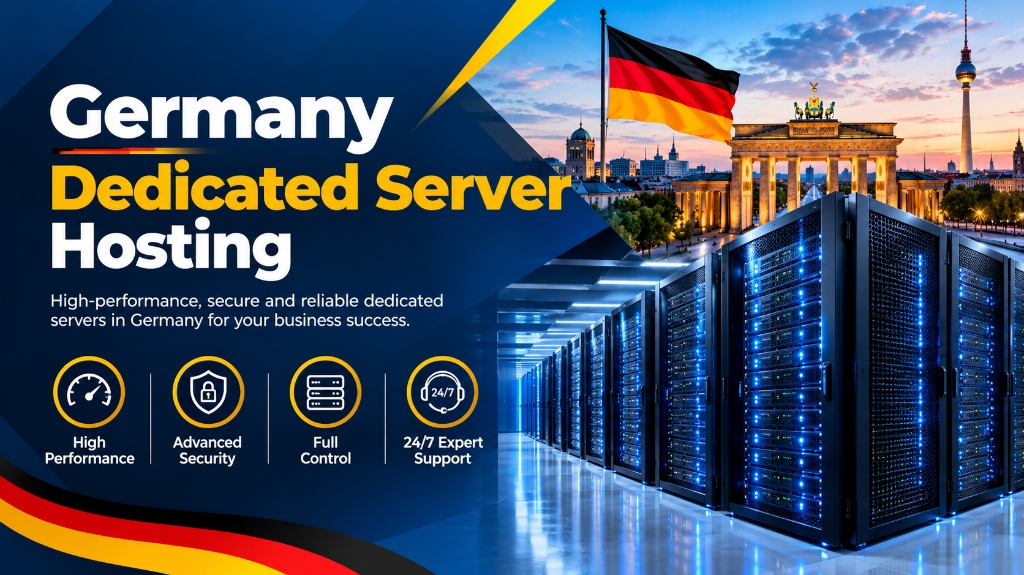
Modern enterprise applications, high-frequency financial platforms, distributed AI inferencing pipelines, and multi-tenant SaaS ecosystems require infrastructure capable of sustained, unthrottled computing power. In virtualized or multi-tenant public cloud environments, noisy neighbors, CPU hypervisor scheduling jitter, and throttled storage I/O often compromise mission-critical service level agreements. Hosting in Germany—specifically within the carrier-dense digital nexus of Frankfurt am Main—offers the highest concentration of network interconnection in continental Europe. Mastering this Germany dedicated server configuration guide provides systems architects, DevOps directors, and IT executives with the technical blueprint to select, provision, harden, and optimize single-tenant bare-metal hardware for unmatched speed, security, and statutory German data sovereignty.
To execute a high-performance Germany dedicated server configuration guide workflow, enterprises must anchor bare-metal hardware inside Tier III Frankfurt datacenters peered directly at DE-CIX. Core architectural pillars include: (1) 100% Dedicated Silicon Isolation deploying AMD EPYC 9004 or Intel Xeon Scalable processors with unshared 12-channel DDR5 ECC registered memory, (2) DE-CIX Frankfurt Peering providing sub-4ms transit across Central Europe and sub-12ms across the broader European Union, (3) PCIe Gen4/Gen5 NVMe RAID 10 Arrays achieving over 1,000,000 random write IOPS with zero virtualization overhead, (4) Out-of-Band Hardware Management utilizing dedicated IPMI/iLO/iDRAC lights-out management for remote BIOS-level control, and (5) Strict BDSG & GDPR Data Sovereignty ensuring that sensitive corporate databases remain legally anchored on German soil.
Overview and Core Architectural Advantages of Germany Dedicated Server Configuration Guide
When engineering mission-critical infrastructure, the choice between virtualized cloud instances and physical single-tenant bare-metal silicon defines the upper limits of your application’s performance and stability. In virtualized environments, a hypervisor abstraction layer continually arbitrates CPU core scheduling, memory translation tables, and disk queues. This virtualization layer introduces unavoidable microsecond-level latency spikes, known as hypervisor jitter, which degrades the throughput of high-concurrency relational databases, algorithmic trading engines, and real-time streaming services.
Deploying an enterprise German dedicated server eliminates virtualization overhead entirely. Operating systems communicate directly with physical CPU instruction pipelines, direct-attached PCIe buses, and registered ECC memory channels. Geographically, Frankfurt am Main is Europe’s premier telecommunications crossroad, housing DE-CIX Frankfurt—the world’s largest carrier-neutral Internet Exchange Point by peak data throughput. Direct interconnection at DE-CIX enables your bare-metal server to exchange traffic with more than 1,000 national, regional, and international transit networks, providing sub-4ms latency across Germany, sub-8ms to Amsterdam and Zurich, sub-10ms to Paris and London, and sub-14ms to Milan and Vienna.
In addition to latency advantages, hosting dedicated hardware in Germany satisfies the strict legal provisions of the Federal Data Protection Act (Bundesdatenschutzgesetz – BDSG) alongside the European General Data Protection Regulation (GDPR). Operating within ISO 27001 certified Tier III Frankfurt facilities ensures that enterprise databases, customer banking records, and sensitive health data remain strictly contained within sovereign German jurisdiction, fully protected from extraterritorial surveillance legislation such as the US CLOUD Act.
Explore our complete bare-metal offerings in our comprehensive Enterprise Dedicated Server Portfolio, or review our scalable virtual cloud solutions in Global Cloud VPS Hosting Plans.
Hardware Resource Sizing and Low-Latency Network Infrastructure
Selecting the appropriate dedicated hardware tier requires aligning computational workloads with physical component specifications. Sizing errors on physical servers cannot be resolved by clicking a slider; they require precise hardware provisioning based on memory bus bandwidth, CPU core counts, PCIe lane availability, and storage throughput.
High-concurrency database clusters (PostgreSQL, MariaDB Galera, Oracle Database) and distributed analytics systems (Elasticsearch, Apache Kafka) demand immense memory bus bandwidth and high-endurance enterprise NVMe storage. Systems running in-memory caching layers (Redis, Memcached) prioritize 12-channel registered DDR5 memory density to prevent memory thrashing. Conversely, container orchestration clusters (Kubernetes worker nodes) and high-traffic web application tiers require high clock frequencies, massive multi-threading capabilities, and redundant 10 Gbps bonded network interfaces.
The provisioning matrix below outlines standardized bare-metal hardware tiers engineered for German and European enterprise production deployments:
| Server Configuration Tier | Processor Architecture | Physical RAM Allocation | Enterprise Storage Array | Network Interface | Target Application Profile |
|---|---|---|---|---|---|
| Entry Enterprise Bare-Metal | Intel Xeon E-2388G (8 Cores, 16 Threads @ 3.2GHz) | 64 GB ECC DDR4-3200MHz | 2x 960 GB Enterprise NVMe (RAID 1) | 1 Gbps Dedicated Port (DE-CIX) | Corporate web portals, dedicated development staging, regional ERP gateways, centralized mail servers |
| Commercial Workhorse | AMD EPYC 7763 (64 Cores, 128 Threads @ 2.45GHz) | 128 GB – 256 GB ECC DDR4 Reg | 4x 1.92 TB NVMe PCIe Gen4 (RAID 10) | 2x 1 Gbps Bonded LACP | High-traffic e-commerce (Magento/WooCommerce), dense Proxmox/VMware clusters, commercial MySQL clusters |
| Hyperscale Compute Core | AMD EPYC 9354 (32 Cores, 64 Threads @ 3.25GHz Genoa) | 256 GB – 512 GB 12-Channel DDR5 Reg | 4x 3.84 TB NVMe PCIe Gen5 (RAID 10) | 10 Gbps SFP+ Dedicated | High-frequency trading backends, distributed microservices, big data processing pipelines, multi-tenant SaaS |
| Dual-Socket Ultra Cluster | Dual AMD EPYC 9654 (192 Cores, 384 Threads @ 2.4GHz) | 1 TB – 1.5 TB Registered ECC DDR5 | 8x 7.68 TB NVMe Enterprise (Hardware RAID) | 2x 10 Gbps Redundant BGP | Large-scale AI model fine-tuning, real-time banking transaction clearing, hyperscale private cloud foundations |
Every Onlive Infotech dedicated server in Germany is provisioned with enterprise-grade server-grade hardware, redundant Hot-Swap power supplies (2N redundancy), and remote out-of-band IPMI 2.0 / iLO / iDRAC management boards. This allows administrators to perform remote hardware reboots, mount virtual ISO installation media, and inspect hardware sensor telemetry without physical datacenter intervention.
Step-by-Step Optimization and Security Hardening Configuration
Deploying bare-metal hardware into an active production environment requires thorough systems engineering across Linux kernel parameters, storage array verification, firewall boundaries, and zero-trust authentication. Implementing these production-grade hardening steps ensures maximum throughput and resilience against cyber threats.
For unified administrative management standards, review our foundational Server Management Configuration Blueprint.
1. Linux Kernel Network Optimization via sysctl.conf (Google BBR & Buffer Sizing)
Default Linux kernel network settings are calibrated for modest general-purpose workstations. On dedicated servers equipped with 1 Gbps or 10 Gbps network interfaces processing millions of packets per second, small network backlog queues cause socket exhaustion. Modifying /etc/sysctl.conf activates Google BBR congestion control and optimizes socket memory allocations for high concurrency.
# ========================================================
# Germany Bare-Metal Enterprise Network & Kernel Tuning
# ========================================================
# Open file descriptor ceilings and virtual memory management
fs.file-max = 4194304
vm.swappiness = 1
vm.dirty_ratio = 10
vm.dirty_background_ratio = 3
# Connection backlog queues for high-concurrency enterprise workloads
net.core.somaxconn = 65535
net.core.netdev_max_backlog = 100000
net.ipv4.tcp_max_syn_backlog = 65535
net.ipv4.tcp_fin_timeout = 15
# Memory buffer allocations for 1Gbps / 10Gbps DE-CIX interfaces
net.core.rmem_max = 33554432
net.core.wmem_max = 33554432
net.ipv4.tcp_rmem = 4096 87380 33554432
net.ipv4.tcp_wmem = 4096 65536 33554432
# Activate Google BBR TCP Congestion Control
net.core.default_qdisc = fq
net.ipv4.tcp_congestion_control = bbr
# SYN flood protection and IP spoofing defense
net.ipv4.tcp_syncookies = 1
net.ipv4.conf.all.rp_filter = 1
net.ipv4.conf.default.rp_filter = 1
net.ipv4.icmp_echo_ignore_broadcasts = 1
EOF
# Apply kernel settings immediately
sysctl -p
2. Hardware NVMe Storage Verification and Filesystem Optimization
Verifying storage array health and configuring production filesystem mount options with noatime eliminates unnecessary write overhead, ensuring the lowest possible disk access latencies.
apt-get update && apt-get install -y nvme-cli smartmontools
nvme list
nvme smart-log /dev/nvme0n1
# Optimize /etc/fstab mount flags for NVMe RAID 10 partitions
# Replace existing mount flags with: noatime,nodiratime,discard,barrier=0
sed -i ‘s/defaults/defaults,noatime,nodiratime/g’ /etc/fstab
# Remount filesystem to apply changes without rebooting
mount -o remount /
3. Zero-Trust SSH Hardening and Stateful Perimeter Firewall
Securing the bare-metal host perimeter requires enforcing Ed25519 cryptographic authentication, relocating SSH from port 22, and deploying a strict default-deny firewall posture.
adduser de_admin
usermod -aG sudo de_admin
# Install Ed25519 authorized key
mkdir -p /home/de_admin/.ssh
chmod 700 /home/de_admin/.ssh
echo “ssh-ed25519 AAAAC3NzaC1lZDI1NTE5AAAAIGermanyDedicatedAdmin2026FrankfurtOps admin@frankfurt-metal” > /home/de_admin/.ssh/authorized_keys
chmod 600 /home/de_admin/.ssh/authorized_keys
chown -R de_admin:de_admin /home/de_admin/.ssh
# Configure /etc/ssh/sshd_config security parameters
sed -i ‘s/#Port 22/Port 2266/’ /etc/ssh/sshd_config
sed -i ‘s/PermitRootLogin yes/PermitRootLogin no/’ /etc/ssh/sshd_config
sed -i ‘s/#PasswordAuthentication yes/PasswordAuthentication no/’ /etc/ssh/sshd_config
sed -i ‘s/X11Forwarding yes/X11Forwarding no/’ /etc/ssh/sshd_config
echo “MaxAuthTries 3” >> /etc/ssh/sshd_config
echo “ClientAliveInterval 300” >> /etc/ssh/sshd_config
echo “ClientAliveCountMax 2” >> /etc/ssh/sshd_config
# Test SSH configuration syntax and restart service
sshd -t && systemctl restart sshd
# Install and configure UFW stateful firewall
apt-get install -y ufw fail2ban
ufw default deny incoming
ufw default allow outgoing
ufw allow 2266/tcp comment ‘Custom SSH Port’
ufw allow 80/tcp comment ‘HTTP Web Port’
ufw allow 443/tcp comment ‘HTTPS SSL Port’
ufw –force enable
systemctl restart fail2ban
systemctl enable fail2ban
For official technical documentation regarding carrier interconnection and German data protection regulations, consult the DE-CIX Frankfurt Technical Specifications and statutory regulatory directives from the Federal Commissioner for Data Protection and Freedom of Information (BfDI).
Benchmark Comparisons vs Standard Cloud Solutions
Enterprise decision-makers frequently weigh dedicated bare-metal servers in Frankfurt against public cloud platforms (such as AWS eu-central-1 Frankfurt or Microsoft Azure Germany West Central). While public clouds offer rapid spinning up of temporary virtual machines, they impose aggressive metered egress pricing, unpredictable compute thread sharing, and high total cost of ownership (TCO) for sustained production workloads.
Onlive Infotech’s Germany dedicated servers provide dedicated physical CPU cores, direct-attached PCIe Gen4/Gen5 NVMe storage, unshared 10 Gbps uplinks, and flat monthly billing with no egress surprises. The performance benchmark table below illustrates real-world differences across key infrastructure parameters:
| Performance Benchmark | Onlive Infotech Germany Bare-Metal | Public Cloud (AWS/Azure Frankfurt) | Generic Shared Hosting Platform |
|---|---|---|---|
| Domestic German & EU Latency | < 3 ms Direct DE-CIX Frankfurt Peering | 4 ms – 8 ms Virtual VPC Transit | 15 ms – 35 ms Unpeered Route |
| CPU Allocation Integrity | 100% Dedicated Physical Silicon (Zero Steal) | Shared / Burstable CPU Credits (Throttled) | Shared Single CPU Pool (High contention) |
| Storage Performance (IOPS) | 1,000,000+ Random Read IOPS (Direct NVMe RAID) | 3,000 Baseline IOPS (Paid provisioned IOPS) | < 8,000 IOPS (Shared spinning/SATA SSD) |
| Bandwidth & Data Egress Costs | Inclusive Unmetered / High-Quota Bandwidth | Metered Egress ($0.08 – $0.12 per GB) | Unmetered (Strict hidden inode limits) |
| BDSG & GDPR Data Sovereignty | 100% Guaranteed Sovereign German Hosting | US CLOUD Act Extraterritorial Reach | Unknown server location distribution |
| Hardware Out-of-Band Control | Full IPMI / iLO / iDRAC BIOS Remote Console | Cloud Dashboard / Serial Console Only | Locked cPanel (No console or root access) |
Frequently Asked Questions
What is Germany dedicated server configuration guide?
Why is Frankfurt the premier datacenter location in continental Europe?
How does bare-metal hardware eliminate hypervisor latency?
What are the statutory advantages of BDSG and GDPR compliance in Germany?
What remote management tools (IPMI / iLO / iDRAC) are provided with German dedicated servers?
What RAID configurations are recommended for PCIe Gen4 NVMe arrays?
What DDoS mitigation protocols protect Onlive Infotech German dedicated servers?
Can I deploy virtualization hypervisors (Proxmox, VMware ESXi, KVM) on my dedicated server?
How do I optimize Linux kernel TCP settings for maximum web concurrency in Germany?
/etc/sysctl.conf by increasing socket backlog limits (net.core.somaxconn = 65535), expanding TCP read and write memory buffers, enabling TCP SYN cookies to defend against SYN flood attacks, and switching the default congestion control algorithm to Google’s model-based BBR (net.ipv4.tcp_congestion_control = bbr).
What operating systems can be deployed on German dedicated servers?
Enterprise Deployment Checklist and Technical Support
Before transitioning your newly provisioned German bare-metal dedicated server into production, review this operational verification checklist. Completing these technical checks ensures that your server satisfies security, performance, and legal compliance benchmarks.
BDSG & GDPR Data Residency Audit: Confirm that all database volumes, user account records, and access logs are physically hosted inside Tier III Frankfurt datacenters.
DE-CIX Route Verification: Run traceroutes across major European telecom networks (Deutsche Telekom, Vodafone, Orange, Telia) to confirm sub-10ms direct peering.
IPMI Out-of-Band Security: Change default IPMI/iDRAC administrative credentials, restrict BMC web access to a dedicated VPN or IP whitelist, and test remote console access.
SSH Cryptographic Hardening: Disable password authentication and root login, configure Ed25519 public key authentication, and relocate the SSH daemon to a custom port.
Kernel Network Tuning: Apply optimized sysctl.conf parameters, activating Google BBR TCP congestion control and expanded socket backlog queues.
NVMe RAID Array Health & Mounts: Verify RAID array status via nvme-cli/megacli and mount partitions with
noatime to eliminate redundant write overhead.
Stateful Firewall & Intrusion Prevention: Activate UFW with default-deny inbound rules and configure Fail2ban with dynamic IP banning on authentication logs.
Automated Backup & Snapshot Schedule: Implement automated daily database dumps and file backups with off-site replication to secondary storage.
Accelerate Your European Enterprise with Onlive Infotech
Harness the power of dedicated AMD EPYC silicon, DE-CIX Frankfurt peering, PCIe Gen4 NVMe speed, and 24/7/365 certified DevOps engineering support.
•

✓
