
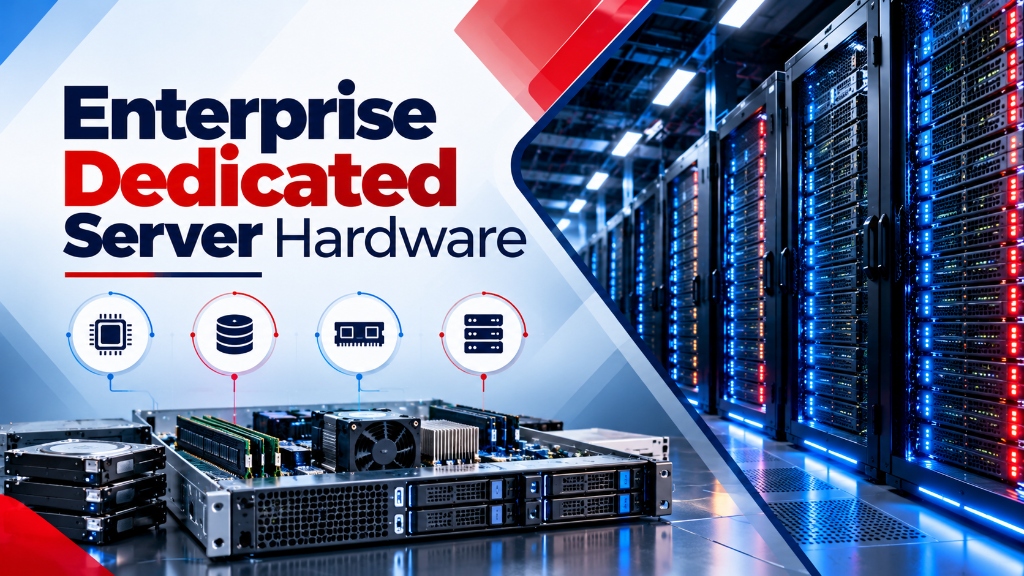
Selecting the optimal bare-metal infrastructure for mission-critical enterprise workloads is one of the most pivotal technical and financial decisions an engineering organization will make. In an era dominated by hyper-scaler cloud marketing, many technology leaders seek expert help choosing dedicated server hosting to escape the compounding expenses of shared public clouds, eliminate unpredictable noisy-neighbor latency spikes, and regain deterministic hardware control.
A dedicated server represents uncompromised physical hardware ownership: 100% of the Central Processing Unit (CPU) instruction cycles, dedicated Error-Correcting Code (ECC) memory channels, direct Non-Volatile Memory Express (NVMe) PCIe bus lanes, and unmetered multi-gigabit network pipes belong exclusively to your operating system. This comprehensive architectural evaluation framework provides systems architects, Chief Technology Officers (CTOs), and DevOps engineers with an exhaustive methodology for sizing compute architectures, vetting datacenter tier standards, benchmarking storage subsystems, and auditing total cost of ownership (TCO).
Strategic Architecture Framework When Seeking Help Choosing Dedicated Server Hosting
The journey toward selecting a dedicated server begins by defining the primary operational bottleneck of your workload. Application architectures typically fall into four distinct resource-bound categories: compute-bound (e.g., video transcode pipelines, mathematical modeling, compiling, cryptographic processing), memory-bound (e.g., in-memory Redis/Memcached caches, real-time analytics, high-density hypervisors), I/O-bound (e.g., transactional databases like PostgreSQL and MySQL, Elasticsearch clusters), or network-bound (e.g., content distribution networks, streaming relays, real-time game servers).
When engineering teams request professional guidance, the initial assessment requires decoupling software design requirements from marketing abstractions. Unlike cloud virtual machines (vCPUs) that share physical processor time via hypervisor thread scheduling, bare metal provides raw physical cores with unshared L1, L2, and L3 CPU cache pools. This architectural distinction directly dictates application throughput and eliminates microarchitectural side-channel vulnerabilities such as Spectre, Meltdown, and Downfall.
Furthermore, evaluating enterprise hosting involves understanding governance, data sovereignty, and hardware lifecycle maintenance. Organizations must ensure that hardware vendors deliver documented Mean Time Between Failures (MTBF), certified replacement Service Level Agreements (SLAs), and out-of-band management access to guarantee uninterrupted operations.
Silicon Shootout: AMD EPYC vs Intel Xeon Architecture Evaluation
Choosing the processor architecture is the foundational hardware decision. Both AMD and Intel deliver sophisticated server-grade microarchitectures, but each caters to different computational optimization targets:
- AMD EPYC (Zen 4 Genoa / Zen 5 Turin): AMD’s Multi-Chip Module (MCM) chiplet design delivers massive core density—ranging up to 128 cores and 256 threads per socket. Featuring 12 channels of DDR5 memory and up to 128 PCIe Gen 5 lanes per socket, AMD EPYC is the undisputed champion for multi-tenant private virtualization (Proxmox VE, VMware ESXi), high-throughput microservices, and extensive parallel batch processing.
- Intel Xeon Scalable (4th & 5th Gen Sapphire Rapids / Emerald Rapids): Intel’s monolithic and tile-based silicon emphasizes built-in workload accelerators. Technologies such as Intel Advanced Matrix Extensions (AMX) accelerate deep learning and AI inference, while Intel QuickAssist Technology (QAT) offloads SSL/TLS cryptographic handshakes and zlib compression directly to hardware silicon, freeing primary CPU cores for core application execution.
For organizations deploying high-frequency trading (HFT) or single-threaded game engines where raw clock cycle frequency supersedes core count, enterprise overclocked Intel Core i9 or AMD Ryzen 9 bare-metal configurations (clocking past 5.5 GHz) provide specialized performance advantages that enterprise multi-socket Xeons cannot match.
Memory Subsystems: Sizing DDR4 vs DDR5 and Error-Correcting Code (ECC) Necessity
Random Access Memory (RAM) sizing must encompass both capacity and bandwidth. Enterprise dedicated servers universally employ Error-Correcting Code (ECC) Registered (RDIMM) memory. Non-ECC memory found in consumer hardware is unacceptable for mission-critical enterprise hosting; soft errors caused by thermal variance and cosmic ray neutron collisions can flip memory bits, resulting in silent database corruption, corrupted filesystem inodes, and sudden operating system kernel panics.
When selecting memory configurations, consider the generational performance leaps between DDR4 and DDR5:
- DDR4 ECC RDIMM: Operating at 2666 MT/s to 3200 MT/s across 6 to 8 memory channels, providing up to 204 GB/s of theoretical memory bandwidth per socket. An excellent, budget-optimized solution for general web hosting, medium-traffic applications, and secondary replica nodes.
- DDR5 ECC RDIMM: Operating at 4800 MT/s to 5600 MT/s across 12 memory channels on modern AMD EPYC 9004 and Intel Xeon 5th Gen platforms, delivering over 460 GB/s of memory bandwidth. Essential for large-scale in-memory databases (SAP HANA, Aerospike, Redis) and real-time streaming analysis.
Always verify that memory modules are deployed in a balanced, multi-channel configuration. Operating a 12-channel CPU with only 4 installed DIMMs forces the memory bus into an unbalanced state, bottlenecking memory throughput by more than 60%.
Storage Subsystems: Enterprise NVMe, SATA SSD, and SAS Architecture
Storage performance directly governs database transaction latency and file I/O operations. A frequent mistake when choosing dedicated servers is conflating consumer-grade M.2 NVMe SSDs with Enterprise-grade U.2, U.3, or E1.S NVMe drives.
Enterprise NVMe drives incorporate hardware Power Loss Protection (PLP) tantalum capacitors. When sudden facility power loss occurs, PLP provides sufficient millisecond energy reserve to flush in-flight data residing in volatile DRAM cache onto persistent NAND flash blocks. Consumer SSDs lack PLP; an abrupt outage frequently leads to corrupt file tables and lost write transactions.
Evaluate storage technologies against operational demands:
- PCIe 4.0 / 5.0 Enterprise NVMe: Up to 14,000 MB/s sequential read/write and 1,000,000+ random 4K IOPS per drive with sustained latencies below 50 microseconds. Ideal for primary database storage, distributed transaction ledgers, and heavy virtualization hosts.
- SATA III / SAS SSDs: Throughput capped at ~550 MB/s (SATA) or ~1,100 MB/s (12G SAS). Suitable for cost-effective OS boot disks, caching layers, and high-capacity static asset delivery.
- High-Capacity Enterprise SAS HDDs (18TB–26TB 7200 RPM): Deployed in high-density storage arrays for object storage, cold archiving, compliance logs, and secondary disaster recovery pools.
RAID Controllers vs Software ZFS Pools: Storage Resilience
Data redundancy is non-negotiable. Even the highest-tier enterprise SSD will eventually encounter media wear or controller failure. The architectural decision lies between Hardware RAID and Software ZFS/mdadm pools.
Hardware RAID controllers (such as Broadcom MegaRAID / LSI) manage storage arrays independently of the host operating system. Equipped with dedicated 4GB–8GB flash-backed write cache (FBWC), they deliver deterministic write caching and offload parity calculations (RAID 5 / RAID 6 / RAID 10). However, they introduce proprietary metadata formats: if the physical RAID card fails, replacing it requires identical or backwards-compatible controller hardware.
Conversely, OpenZFS has emerged as the modern enterprise standard for software-defined storage. ZFS combines volume management and filesystem operations with 256-bit cryptographic checksums on every block, detecting and automatically repairing silent data corruption (bit rot) via mirror or parity disks.
The following script creates an enterprise-hardened mirrored ZFS pool across dual enterprise NVMe drives, configuring direct record sizing and disabling unnecessary access time updates:
# Inspect attached PCIe NVMe storage devices
ls -la /dev/disk/by-id/nvme*

# Create ZFS Mirror with ashift=12 (4K sector alignment)
zpool create -f -o ashift=12 -O compression=zstd-3 -O atime=off -O xattr=sa \
    datapool mirror \
    /dev/disk/by-id/nvme-Micron_7450_MTFDKCC3T8TFR_230134AB001 \
    /dev/disk/by-id/nvme-Micron_7450_MTFDKCC3T8TFR_230134AB002

# Set dedicated dataset for database operations with 16k recordsize
zfs create -o recordsize=16k -o logbias=latency datapool/mysql_data

# Validate storage pool configuration
zpool status datapool
Network Connectivity, Bandwidth Allocation, and Uplink Architecture
A high-performance dedicated server is only as effective as the network pipes connecting it to the global internet. When evaluating network specifications, examine three key dimensions: physical port speed, uplink redundancy, and bandwidth commitment models.
Physical network ports range from 1 Gbps up to 100 Gbps. Enterprise deployments require redundant dual-port Network Interface Cards (NICs) connected to independent Top-of-Rack (ToR) switches using Link Aggregation Control Protocol (LACP – 802.3ad). This architecture ensures that if a physical cable, transceiver, or switch crashes, system traffic continues uninterrupted.
Bandwidth pricing structures generally fall into two models:
- Unmetered Flat-Rate Bandwidth: A dedicated, unshared physical port capacity (e.g., dedicated 1 Gbps, 10 Gbps, or 25 Gbps unmetered). Ideal for media streaming, SaaS backends, and VPN gateways where traffic volume is continuous and data transfer costs must remain strictly predictable.
- Burstable 95th Percentile Billing: Allows servers to burst to maximum physical port line speed, discarding the top 5% of peak usage samples during monthly invoice calculations. Beneficial for applications with predictable baseline traffic punctuated by brief seasonal spikes.
Datacenter Tier Standards, Redundancy, and Carrier-Neutral Facilities
Datacenter infrastructure quality directly determines physical server survivability. The Uptime Institute classifies datacenters into four distinct tiers based on infrastructure topology and fault tolerance:
| Datacenter Classification | Power & Cooling Path Architecture | Annual Downtime SLA | Fault Tolerance Level |
|---|---|---|---|
| Tier I (Basic Capacity) | Single path for power and cooling, no redundant components | Up to 28.8 hours (99.671%) | Vulnerable to both planned and unplanned disruptions |
| Tier II (Redundant Capacity) | Single path with redundant components (N+1 generators/UPS) | Up to 22.0 hours (99.741%) | Maintenance requires system shutdowns |
| Tier III (Concurrently Maintainable) | Multiple power/cooling paths, one active; redundant N+1 components | Under 1.6 hours (99.982%) | Zero downtime during planned hardware maintenance |
| Tier IV (Fault Tolerant) | Multiple active power and cooling paths, 2(N+1) redundancy | Under 26.3 minutes (99.995%) | Survives any unplanned catastrophic event without disruption |
For mission-critical production environments, Tier III or Tier IV carrier-neutral facilities are the industry gold standard. Carrier-neutral facilities house multiple Tier-1 transit providers (e.g., Lumen, Arelion, NTT, Cogent) and direct peering to regional Internet Exchange Points (IXPs), ensuring automated BGP route rerouting around international fiber cuts.
Out-of-Band Remote Management: IPMI, iDRAC, iLO, and Serial-over-LAN
Bare-metal administrators must maintain full out-of-band (OOB) control over physical hardware. Whether recovering from a misconfigured kernel parameter, repairing a damaged network interface, or installing an operating system from a custom ISO image, out-of-band management provides unmediated keyboard, video, and mouse (KVM) access.
Industry-standard Baseboard Management Controllers (BMCs) include:
- Dell iDRAC9 Enterprise: Delivers HTML5 virtual consoles, granular power capping, hardware inventory diagnostics, and Redfish REST API automation.
- HPE Integrated Lights-Out (iLO 6): Features Silicon Root of Trust security, automated firmware validation, and continuous thermal telemetry.
- Supermicro IPMI 2.0 / MegaRAC: Provides standards-compliant IPMI over LAN, Serial-over-LAN (SoL), and remote ISO mounting capabilities.
The following bash command demonstrates initiating a secure out-of-band power cycle using standard IPMI tools from an administrative bastion host:
# Check physical power status via out-of-band IPMI
ipmitool -I lanplus -H 10.200.15.50 -U admin -P SecureAdminPass2026! power status

# Perform an emergency hardware reset
ipmitool -I lanplus -H 10.200.15.50 -U admin -P SecureAdminPass2026! power reset

# Access remote Serial-over-LAN (SoL) text console
ipmitool -I lanplus -H 10.200.15.50 -U admin -P SecureAdminPass2026! sol activate
Ensure that management interfaces are locked down behind dedicated out-of-band private networks and never assigned public internet IP addresses.
Operating System Choices: Debian, Ubuntu LTS, RHEL, Rocky Linux, and Proxmox VE
The choice of server operating system dictates security lifecycle maintenance, package availability, and system stability. Dedicated servers support any x86_64 or ARM64 operating system:
- Ubuntu Server 22.04 / 24.04 LTS: The standard platform for modern cloud-native software stacks, Docker containers, Kubernetes nodes, and developer-centric tooling. Five-year Long Term Support (LTS) lifecycle.
- Debian 12 (Bookworm): Legendary for conservative stability, minimal default packages, and exceptional reliability. Favored by systems engineers who require deterministic software behavior without frequent breaking changes.
- Rocky Linux 9 / AlmaLinux 9: 1:1 binary-compatible downstream distributions of Red Hat Enterprise Linux (RHEL). Engineered for enterprise corporate compliance, SELinux enforcement, and commercial software certifications (cPanel/WHM, Oracle Database).
- Proxmox VE (Virtual Environment): A bare-metal hypervisor platform based on Debian and OpenZFS. Converts a single dedicated physical server into an enterprise virtualization cluster supporting KVM virtual machines and lightweight LXC containers managed through a responsive web GUI and REST API.
Security Hardening, Anti-DDoS Defenses, and Compliance Controls
Physical dedicated servers operate directly on public IP subnets, exposing network ports to automated internet port scanners, credential stuffing, and volumetric Distributed Denial of Service (DDoS) attacks.
Robust server management incorporates multi-layered security controls:
- Upstream Anti-DDoS Scrubbing: Datacenter-level edge hardware (such as Corero SmartWall, Arbor Sightline, or Cloudflare Magic Transit) inspects inbound packets at terabit speeds, filtering volumetric UDP reflection, SYN floods, and DNS amplification attacks before they overwhelm physical server uplinks.
- Host-Level Packet Filtering: Deploying
nftableswith a strict default-drop inbound policy, stateful connection tracking, and rate limiting on remote administrative ports. - Cryptographic Authentication: Disabling password authentication on SSH entirely, mandating Ed25519 public key cryptography, and moving SSH listening ports away from standard port 22 to reduce log noise.
- Host Intrusion Prevention: Installing
fail2banorcrowdsecto automatically ban abusive IP subnets that exhibit suspicious behavior.
Total Cost of Ownership (TCO): Bare Metal vs Public Cloud Hyperscalers
Financial considerations frequently drive the decision to adopt dedicated servers. Public cloud providers (AWS, Google Cloud, Microsoft Azure) utilize utility-based pricing models that introduce severe hidden operational costs as digital operations scale.
Examine the Total Cost of Ownership (TCO) comparison for an enterprise database workload processing 50 TB of monthly outbound data transfer over a 3-year operational window:
| Cost / Operational Component | Enterprise Dedicated Server (AMD EPYC 32-Core, 128GB RAM, 2x 3.84TB NVMe) | Public Cloud Hyperscaler (Equivalent 32 vCPU Compute + Provisioned IOPS) | 3-Year Financial Impact |
|---|---|---|---|
| Monthly Compute Instance Cost | $280 – $380 / month (Fixed) | $1,150 – $1,450 / month (Variable) | Bare metal saves ~$30,000 in raw compute fees |
| Storage IOPS Provisioning Fees | $0 (Unthrottled hardware NVMe) | $350 – $600 / month for 64,000 IOPS | Bare metal saves ~$15,000 in storage fees |
| Network Data Egress (50 TB/month) | $0 (Included Unmetered 1Gbps/10Gbps) | $2,500 – $4,000 / month ($0.05–$0.08/GB) | Bare metal saves ~$100,000 in egress penalties |
| Total 3-Year Estimated Expenditure | ~$11,500 – $14,500 | ~$145,000 – $215,000 | > 90% Cost Reduction at Scale |
For steady-state production workloads, dedicated bare-metal hosting eliminates the exorbitant data transfer taxes and provisioned IOPS surcharges that plague enterprise cloud balance sheets.
Frequently Asked Questions
How do I determine whether my application requires dedicated server hosting?
Dedicated hosting is essential when your application requires unthrottled CPU performance, sustained high-IOPS NVMe storage, strict regulatory compliance (GDPR, HIPAA, PCI-DSS), large memory footprints, or when public cloud bandwidth egress bills become financially unsustainable.
What is the performance difference between a physical CPU core and a cloud vCPU?
A physical CPU core represents dedicated execution pipelines, arithmetic logic units, and dedicated L1/L2 cache. A cloud vCPU is merely a single hyper-threaded virtual execution thread scheduled on a shared core, frequently suffering from 30% to 50% performance degradation due to hypervisor overhead and noisy-neighbor contention.
Why is ECC memory mandatory for enterprise dedicated servers?
Error-Correcting Code (ECC) memory incorporates dedicated parity chips to actively detect and correct single-bit memory errors in real time. Without ECC, electrical fluctuations and cosmic radiation cause silent memory bit flips, leading to database corruption and sudden system kernel panics.
What is the advantage of enterprise NVMe over consumer-grade NVMe SSDs?
Enterprise NVMe drives include hardware Power Loss Protection (PLP) capacitors to preserve in-flight writes during power cuts, feature 10x higher write endurance (DWPD ratings), and maintain consistent sub-millisecond latencies under sustained high queue depths, unlike consumer drives which throttle heavily under sustained load.
What does out-of-band management (IPMI / iDRAC) allow an administrator to do?
Out-of-band management provides a dedicated, independent hardware interface (operating on an isolated network chip) that allows administrators to power cycle the server, configure BIOS/UEFI settings, mount remote ISO installation media, and access keyboard/video consoles even when the operating system is completely crashed or offline.
How does unmetered bandwidth compare to 95th percentile bandwidth billing?
Unmetered bandwidth provides a fixed, continuous port capacity (e.g., 1 Gbps or 10 Gbps) at a flat monthly cost with zero overage charges. 95th percentile billing allows bursting to high speeds while discarding the top 5% of peak usage readings, charging based on the remaining 95th percentile benchmark.
What is the difference between Tier III and Tier IV datacenters?
Tier III datacenters provide concurrently maintainable infrastructure with N+1 redundant power and cooling, guaranteeing 99.982% uptime. Tier IV datacenters provide fully fault-tolerant infrastructure with 2(N+1) active redundant paths, surviving catastrophic component failures without any operational downtime (99.995% uptime).
Can I run virtual machines on a single dedicated server?
Yes. Installing hypervisors such as Proxmox VE, VMware ESXi, or KVM allows you to carve a single physical bare-metal server into dozens of isolated virtual machines or containers with zero multi-tenant public cloud overhead, maximizing hardware utilization.
How does hardware anti-DDoS mitigation operate on dedicated servers?
Upstream datacenter scrubbing centers inspect inbound network packets using hardware filters (such as Arbor Networks), diverting volumetric malicious traffic (UDP floods, SYN floods) to scrubbing farms where bad packets are dropped while clean application traffic is forwarded to your server.
What hardware replacement SLAs should I look for in a hosting contract?
Enterprise hosting providers must guarantee rapid physical hardware replacement in writing. Look for SLAs specifying 2-hour to 4-hour hardware replacement for failed components (CPUs, RAM modules, power supplies, and NVMe drives) backed by certified on-site datacenter technicians.
Enterprise Dedicated Server Hardware Procurement and Deployment Checklist
Before executing an enterprise hardware procurement contract or provisioning a new dedicated server fleet, engineering leads should review this comprehensive pre-flight procurement checklist:
- Silicon Match: Ensure CPU architecture aligns with application workload (high frequency vs high core count; verify AVX-512 / QAT accelerator requirements).
- Memory Architecture: Confirm DDR5 or DDR4 ECC Registered modules configured in balanced multi-channel layout across all CPU memory sockets.
- Storage Endurance: Verify enterprise-tier NVMe storage with Power Loss Protection (PLP) and minimum 1.0 DWPD write endurance rating.
- Controller Topology: Choose between Hardware RAID with battery-backed write cache (BBU) or Software OpenZFS with mirrored vdevs.
- Network Port Redundancy: Require dual-homed 10GbE or 25GbE interfaces supporting 802.3ad LACP bonding connected to independent top-of-rack switches.
- Datacenter Certification: Verify facility Tier III or Tier IV certification, carrier neutrality, and minimum N+1 generator and UPS power backup.
- Out-of-Band Remote Access: Ensure dedicated iDRAC9, iLO6, or IPMI 2.0 access with HTML5 virtual console and virtual media mounting.
- Security & Anti-DDoS: Verify multi-terabit upstream automated DDoS scrubbing and define host-level packet filtering policies.
- Hardware Replacement SLA: Obtain contractual commitment for 2-hour to 4-hour on-site replacement for failed hardware components.
- Total Cost of Ownership Modeling: Audit 36-month projections including unmetered bandwidth allowances to verify economic ROI against cloud hyperscalers.
By applying these rigorous criteria, organizations seeking help choosing dedicated server hosting will procure reliable, high-performance, and economically sustainable bare-metal infrastructure built to support mission-critical enterprise applications for years to come.
