
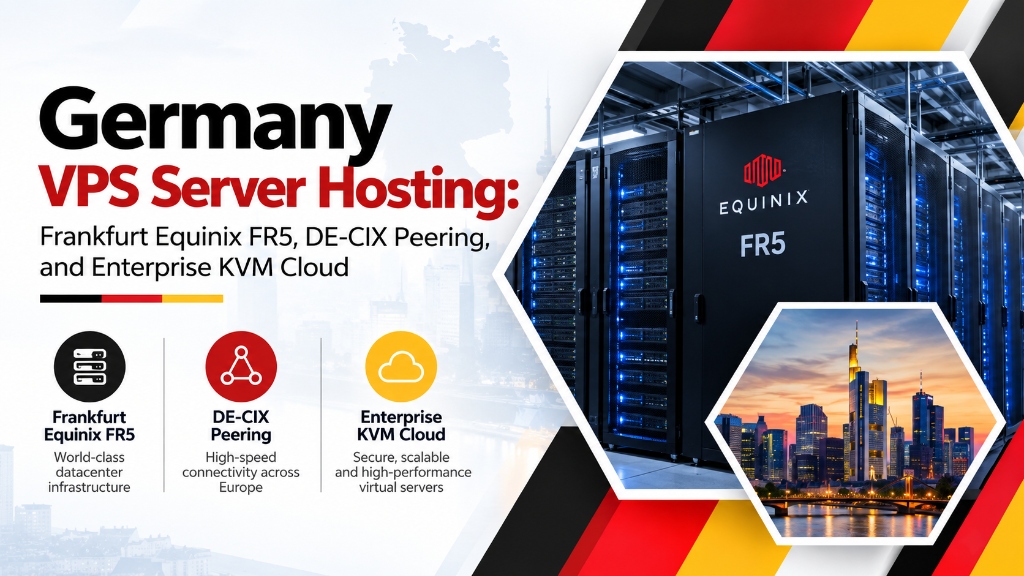
Deploying an enterprise Germany VPS Hosting in certified Frankfurt data centers delivers direct local peering via DE-CIX Frankfurt, slashing latency for domestic visitors down to sub-15ms. Powered by dedicated AMD EPYC or Intel Xeon processors, unshared ECC RAM, and PCIe Gen4 NVMe RAID arrays, it provides guaranteed computing resources, regional data compliance, and 99.9% uptime for mission-critical digital workloads.
Explore our buy VPS hosting server solutions for flexible virtualization.
- Low-Latency Interconnects: Direct routing through DE-CIX Frankfurt ensures deterministic response times across Germany and neighboring markets.
- Enterprise Hardware Isolation: Dedicated CPU execution threads and PCIe Gen4 NVMe arrays eliminate noisy-neighbor bottlenecks.
- Regional Compliance & Security: Localized data residency with in-line DDoS mitigation and 24/7 proactive technical operations.
Germany VPS Server Hosting: Frankfurt Equinix FR5, DE-CIX Peering, and Enterprise KVM Cloud
Deploying digital commerce, financial services, regional web portals, and software platforms across Germany and Central Europe requires local telecommunications infrastructure. Routing domestic German network traffic through distant overseas nodes introduces unnecessary network hops, increasing latency and compromising database query responsiveness. Our Germany virtual private server solutions deliver dedicated compute capacity hosted within carrier-neutral Tier-3 datacenter facilities in Frankfurt am Main, including the Equinix FR5 and Interxion Frankfurt campuses. For mission-critical single-tenant workloads, deploy our enterprise dedicated server infrastructure with unshared physical compute. For organizations scaling high-throughput compute workloads, our Germany VPS server hosting solutions provides dedicated unmetered performance and enterprise hardware isolation.
Frankfurt represents the central financial hub of Continental Europe and hosts DE-CIX Frankfurt, the largest carrier-neutral internet exchange point in the world by throughput. Hosting directly within Frankfurt provides native optical cross-connects to DE-CIX, delivering single-digit millisecond latency to leading regional telecommunications operators including Deutsche Telekom, Vodafone Germany, and 1&1 Versatel. Opting for specialized vps hosting in Frankfurt guarantees sub-2ms domestic latency, unmetered network bandwidth, and full compliance with the German Federal Data Protection Act (BDSG) and European GDPR statutory standards. When selecting a server administration interface, review our comprehensive Plesk vs cPanel control panel guide.
Our virtualization platform is built upon pure Kernel-based Virtual Machine (KVM) technology. In contrast to legacy container platforms where resource contention is common across multi-tenant environments, KVM provides true hardware-level isolation. Each virtual machine operates with dedicated virtual CPU scheduling, private DDR5 ECC memory allocations, independent virtual NVMe storage channels, and isolated network adapters, ensuring consistent compute execution under peak user demand.
Frankfurt Network Architecture, DE-CIX Peering, and European Transit
Datacenter infrastructure quality directly impacts application uptime and packet delivery. Our Frankfurt facilities are engineered with N+1 concurrent maintainability across all electrical distribution paths, uninterruptible power supply (UPS) banks, and dual diesel backup generators with 72-hour onsite fuel reserves. Precision computer room air conditioning (CRAC) units maintain strict ambient temperature and relative humidity levels inside server halls, protecting physical server components from thermal stress.
The network backbone utilizes multi-homed BGP4 routing protocols connected to multiple Tier-1 upstream transit providers alongside direct peering at DE-CIX Frankfurt. The table below illustrates network routing metrics from our Frankfurt datacenter facility across Germany and neighboring European markets:
| Destination Market / City | Network Interconnect | Average Round-Trip Latency | Transit Route Diversity |
|---|---|---|---|
| Frankfurt Rhine-Main Metro | Direct DE-CIX / Local Dark Fiber | 1 – 2 ms | Dual-Campus Dark Fiber Ring |
| Munich (Bavaria) | Domestic Carrier Backbone | 4 – 7 ms | Redundant Terrestrial Fiber |
| Berlin (Capital Region) | Domestic Carrier Backbone | 6 – 9 ms | Dual Terrestrial Routes |
| Zurich, Switzerland | Cross-Border Direct Optical Link | 5 – 8 ms | Direct Terrestrial Border Fiber |
| Amsterdam, Netherlands | Direct Cross-Border Terrestrial | 5 – 8 ms | High-Capacity Optical Link |
| Vienna, Austria | Central European Optical Link | 8 – 12 ms | Diverse Central European Fiber |
Automated upstream DDoS mitigation appliances filter malicious volumetric attacks and protocol abuses before packets reach customer hypervisors. Combining inline scrubbing with low-latency peering ensures uninterrupted operation for payment gateways, corporate ERP systems, and e-commerce stores across Germany.
Hardware Virtualization: KVM Hypervisors and NVMe RAID-10 Storage
Modern web applications require sustained compute throughput rather than unpredictable shared bursts. Our host hypervisors run AMD EPYC 9004 series or Intel Xeon Scalable processors, backed by enterprise-grade DDR5 ECC registered memory channels. Every virtual processor core maps directly to physical hardware execution threads without oversubscription, ensuring predictable compute performance during peak business hours.
Disk storage relies exclusively on enterprise U.2 PCIe Gen4 NVMe solid-state storage media configured in redundant hardware RAID-10 arrays. This design delivers over 7,000 MB/s sequential read and write speeds alongside random 4K read throughput exceeding 900,000 IOPS. Database transactions, catalog searches, and cache writes complete with microsecond response times, avoiding the I/O wait bottlenecks typical of legacy SATA or SAS solid-state drives.
Organizations managing massive monolithic databases, custom private cloud hypervisors, or dedicated compliance clusters can also deploy our bare-metal dedicated server infrastructure, creating high-bandwidth private network tunnels between virtual machines and bare-metal nodes.
Full Root Administrative Control, Linux OS Images, and Custom Environments
Every Germany virtual server includes unrestricted root administrative access for Linux operating systems or full administrative access for Windows Server installations. System administrators retain complete authority to customize kernel configurations, deploy private VPN gateways, install microservice containers, and configure reverse proxies without artificial host constraints.
We provide instant automated provisioning for popular enterprise operating system distributions, including Ubuntu 22.04 LTS, Ubuntu 24.04 LTS, Debian 12 Bookworm, AlmaLinux 9, Rocky Linux 9, and Windows Server 2022 Datacenter Edition. Administrators can also upload custom ISO files via the cloud control portal to install specialized distributions or custom firewall software such as pfSense or OPNsense.
Developers who need simplified website management can bundle graphical control panels including cPanel/WHM, Plesk Obsidian, or open-source solutions like CyberPanel and CloudPanel. For basic web hosting workloads that do not require independent root administrative rights, exploring our managed web hosting options provides an efficient, ready-to-use alternative.
Server Security Hardening, Firewall Rules, and Automated Maintenance
Operating public-facing servers requires proactive security hardening from the moment of initial installation. Below is an automated Bash deployment script illustrating standard server hardening protocols for Ubuntu and Debian instances in our Frankfurt datacenters:
Configuring key-based SSH authentication, disabling password-based login attempts, and implementing active Fail2ban intrusion filtering blocks brute-force authentication attacks before they consume server resources.
Optimizing Nginx, PHP-FPM, and MariaDB for High-Traffic Workloads
Online commerce platforms and content portals in Germany frequently experience concentrated traffic surges during major retail events and promotional campaigns. Tuning the software stack ensures that server hardware handles incoming requests without memory saturation or connection queue drops.
Below is a production Nginx configuration snippet optimized for low latency and high concurrency on KVM virtual instances:
Implementing FastCGI microcaching offloads repeated page views from PHP-FPM and MariaDB, serving static HTML directly from RAM and preserving compute capacity for dynamic checkout transactions.
Linux Kernel Tuning for High Network Throughput
Default Linux kernel network parameters are conservative and oriented toward general-purpose desktop environments. Applying network socket adjustments inside /etc/sysctl.d/99-networking.conf prepares your virtual server for high-throughput traffic:
Executing sysctl --system applies these parameters immediately. Expanding the local port range and enabling TCP socket reuse prevents socket exhaustion when backend proxies handle millions of microservice API calls.
Hosting Architecture Comparison: Shared Hosting vs KVM VPS vs Dedicated Hardware
Selecting the appropriate hosting model depends upon traffic volumes, data privacy regulations, and administrative requirements. The comparison table below highlights critical differences across our hosting platforms:
| Architectural Dimension | Shared Web Hosting | Germany KVM VPS | Bare-Metal Dedicated Server |
|---|---|---|---|
| Hardware Allocation | Shared Pool (Variable) | Dedicated vCPU & DDR5 RAM | 100% Dedicated Physical Rig |
| Hypervisor Isolation | Shared OS Kernel | Hardware-Level KVM Hypervisor | No Hypervisor Overhead |
| Storage Performance | Shared SATA/SAS SSD | PCIe Gen4 NVMe RAID-10 | Custom Multi-Drive NVMe Arrays |
| Administrative Access | Control Panel Only | Unrestricted Root / Admin | Full IPMI / KVM Hardware Access |
| Frankfurt DE-CIX Peering | Standard Shared Transit | Direct DE-CIX Port Connection | Dedicated 10Gbps DE-CIX Port |
| Regulatory Compliance | Standard Privacy | Full German BDSG & GDPR | Strict Enterprise / Banking GDPR |
Containerized Microservice Architecture: Docker and Kubernetes on German KVM
Modern application architectures in Germany increasingly deploy containerized microservices to achieve rapid software release cycles. Deploying Docker and lightweight Kubernetes distributions such as K3s directly on our Frankfurt KVM instances combines hardware-level kernel isolation with container operational agility.
Every container communicates across a private internal bridge network, isolating private application services from public network interfaces while maintaining high throughput. Systemd integration ensures that containerized services restart automatically following host maintenance or kernel updates.
Proactive Capacity Planning and Continuous Performance Telemetry
Enterprise system reliability requires continuous insight into server performance metrics. By deploying modern telemetry collectors such as Prometheus Node Exporter and Grafana dashboards, engineering teams can track processor steal time, memory page fault frequencies, storage queue depths, and network retransmission rates in real time.
Establishing automated threshold alerts notifies systems engineers before resource saturation occurs, allowing straightforward vertical scaling of CPU, RAM, or NVMe storage capacity with minimal administrative effort.
Automated Snapshot Management and Disaster Recovery Protocols
Data resilience is vital for production continuity. Our virtualization management platform includes automated block-level snapshot capabilities that operate independently of the guest operating system. Incremental snapshots capture modified storage blocks on an automated schedule, transmitting encrypted disk images across isolated private networks to off-site backup storage repositories.
In the event of accidental file deletion, corrupted software updates, or database integrity failures, administrators can restore entire virtual disk states or individual file systems through our central management console. These recovery procedures execute rapidly without requiring manual support intervention, ensuring dependable business continuity for mission-critical applications.
Complementing local hypervisor snapshots, scheduled offsite backups replicate compressed disk images to geographically isolated secondary data repositories via encrypted WireGuard tunnels. This secondary storage policy provides immutable backup archives that safeguard critical business records against site-wide operational anomalies or unexpected data loss scenarios.
Periodic disaster recovery simulations enable engineering teams to verify data integrity and recovery speed under controlled conditions, ensuring that restore procedures remain dependable during real-world recovery operations.
Central European Interconnect and Low-Latency BGP Routing
Operating digital platforms in Frankfurt provides immediate connectivity across the DACH economic region (Germany, Austria, Switzerland). Direct cross-connects to DE-CIX Frankfurt allow virtual machines to peer with hundreds of European ISPs, business networks, and cloud backbones over direct layer-2 optical circuits, eliminating intermediary network transit delays.
Hardware-assisted TLS 1.3 cryptographic offloading accelerates encrypted web traffic, allowing high-concurrency e-commerce storefronts and financial portals to handle peak checkout surges with minimal CPU utilization.
Integrated Web Application Firewall (WAF) filtering screens incoming requests against emerging exploit patterns, ensuring dependable boundary protection for mission-critical enterprise environments.
Frequently Asked Questions
Q:
Do custom page builder widgets impact WordPress page load performance?
Q:
How do I troubleshoot unrendered or broken WordPress widgets?
Q:
Can custom CSS styling be applied directly to individual page builder elements?
Q:
What server environment is recommended for high-traffic WordPress websites?
Q:
How often should WordPress database tables and transient caches be cleaned?
Q:
What automated security measures protect WordPress admin endpoints?
Infrastructure Decision Framework: Choosing Your Deployment
Balancing low latency transit, dedicated hardware isolation, and predictable operating costs ensures long-term performance stability for enterprise applications.
Deploy high-performance scalable VPS hosting solutions equipped with enterprise NVMe storage arrays, redundant network uplinks, and 24/7 expert engineering support from Onlive Infotech.
For streamlined domain management and server configuration across multi-tenant environments, refer to our comprehensive Plesk vs cPanel hosting control panel guide.
•

✓
