
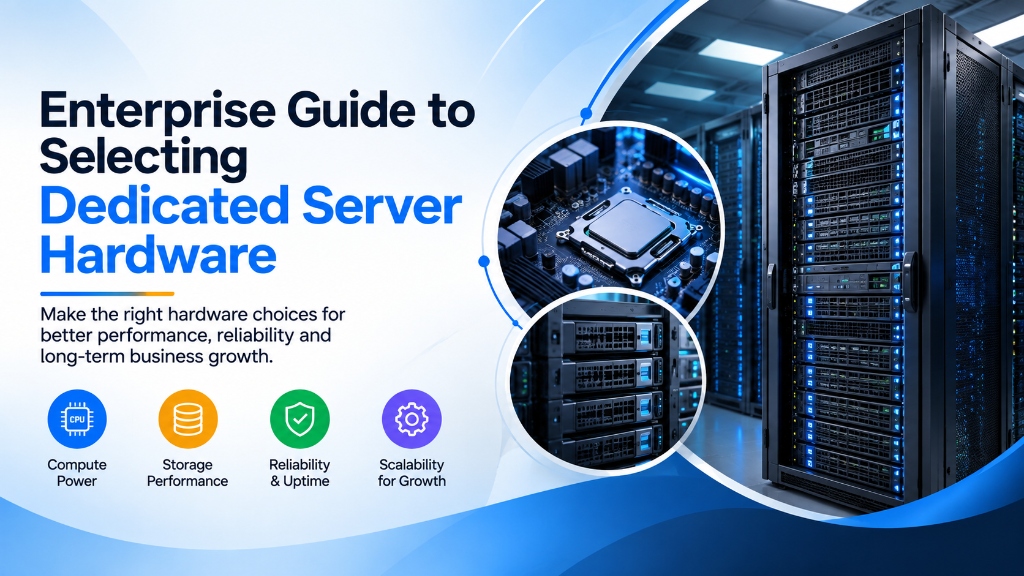
Deploying an enterprise Dedicated Server from Onlive Infotech delivers hardware-isolated computing resources, enterprise PCIe Gen4 NVMe storage arrays, and multi-gigabit Tier-1 network uplinks. It provides scalable performance, deterministic I/O throughput, and complete administrative control with 99.9% uptime SLA.
Explore our flexible VPS hosting plans for flexible virtualization.
- High-Throughput Compute: Physical core reservations with zero hypervisor contention guarantee predictable application performance.
- PCIe Gen4 NVMe Arrays: High-IOPS solid-state storage accelerates database queries, caching layers, and web application response times.
- Enterprise Network Uplinks: Redundant carrier feeds and automated DDoS filtering preserve service continuity under intense traffic spikes.
Procuring enterprise bare-metal infrastructure requires a rigorous engineering evaluation that extends far beyond superficial headline pricing. When technical directors and infrastructure architects evaluate dedicated server solutions, evaluating component microarchitecture, memory channel configurations, PCIe root complex topologies, and upstream carrier diversity is essential. In modern enterprise hosting, a cost-effective bare-metal platform must deliver uncompromised silicon performance, deterministic storage I/O, and carrier-neutral networking. Deploying an enterprise-grade dedicated server establishes the technical foundation necessary for sustained operational resilience. For mission-critical single-tenant workloads, deploy our high-availability cloud server infrastructure with unshared physical compute. For organizations scaling high-throughput compute workloads, our Cheap dedicated server hosting infrastructure provides dedicated unmetered performance and enterprise hardware isolation.
Operating single-tenant bare-metal infrastructure completely eliminates the virtualization hypervisor layer. Your operating system kernel directly addresses physical processor execution pipelines, 12-channel DDR5 ECC memory buses, and PCIe Gen5 NVMe storage channels. For organizations outgrowing the resource limitations of entry-level VPS hosting or migrating from traditional web hosting configurations, dedicated server architecture provides the physical foundation necessary for continuous service availability and rigorous SLA adherence. When selecting a server administration interface, review our comprehensive Plesk vs cPanel control panel guide.
Auditing CPU Silicon: Core Density, IPC, and Vector Instruction Sets
The central processing unit dictates overall computational throughput and software licensing economics. Rather than comparing basic core counts, infrastructure architects must examine Instructions Per Cycle (IPC), base and turbo clock frequencies, Level 3 cache pool topologies, and dedicated hardware acceleration instruction sets.
Modern server platforms offer distinct microarchitectural strengths. AMD EPYC 9004 series processors (featuring up to 128 cores and 256 threads per socket) offer unparalleled multi-threaded compute density for container orchestration and background worker queues. Intel 4th and 5th Gen Xeon Scalable processors feature Intel Advanced Matrix Extensions (AMX) and QuickAssist Technology (QAT), accelerating AI inference and line-rate TLS cryptographic offloading directly in silicon.
Enterprise Hardware Sizing Matrix
| Platform Tier | CPU Configuration | Memory Subsystem | Storage Architecture | Network Uplinks | Primary Workload Profile |
|---|---|---|---|---|---|
| Compute Standard | AMD EPYC 9354P (32C/64T @ 3.25GHz) | 128GB DDR5-4800 ECC | 2x 1.92TB PCIe Gen4 NVMe | 2x 10GbE LACP Bonded | E-Commerce Portals, Redis Caching |
| Database Intensive | Dual AMD EPYC 9554 (128C/256T @ 3.10GHz) | 512GB DDR5-4800 ECC | 4x 3.84TB U.2 Enterprise NVMe | 2x 25GbE Mellanox CX-6 | High-Concurrency PostgreSQL, MySQL |
| Enterprise Flagship | Dual AMD EPYC 9654 (192C/384T @ 2.40GHz) | 1,024GB DDR5-4800 ECC | 8x 3.84TB PCIe Gen5 NVMe | 2x 25GbE Redundant SFP28 | Bare-Metal Kubernetes, Big Data |
| FinTech Accelerator | Dual Intel Xeon Platinum 8480+ (112C/224T) | 512GB DDR5-4800 ECC | 4x 1.92TB PCIe Gen5 NVMe | 2x 25GbE Ultra-Low Latency | Algorithmic Execution, Quantitative Modeling |
Memory Subsystems: Channel Count, Bus Width, and ECC Reliability
Memory bandwidth represents a critical determinant of transactional throughput. Dual-socket AMD EPYC systems provide 12 DDR5 memory channels per socket, creating 24 physical channels across the motherboard. Operating at 4800 MT/s, this layout delivers over 460 GB/s of theoretical memory bandwidth per processor. This expansive bus ensures that execution cores remain continuously supplied with instructions and data, preventing stall cycles during large in-memory database index queries.
Error-Correcting Code (ECC) registered memory is mandatory for enterprise production. ECC circuits detect and correct single-bit memory flips caused by cosmic ray ionization and thermal fluctuations, completely preventing unpredictable operating system kernel panics and database corruption.
Storage Subsystem Architecture: Direct-Attached PCIe Gen5 NVMe
Storage performance in modern bare-metal infrastructure is powered by Non-Volatile Memory Express (NVMe) solid-state storage communicating directly over dedicated PCIe lanes. Unlike legacy SATA solid-state drives constrained by legacy AHCI controllers (limited to 32 command queues with 1 command per queue), NVMe protocols support up to 64,000 independent queues with 64,000 commands per queue. This architectural leap enables sustained random I/O performance exceeding 1,200,000 IOPS per physical drive.
Enterprise U.2 and E3.S form-factor drives incorporate onboard Power Loss Protection (PLP) capacitors. In the event of an unexpected facility power failure, PLP circuitry supplies auxiliary power to flush in-flight DRAM write buffers to non-volatile NAND flash memory. This eliminates write-hole data corruption risks during high-frequency relational database transactions.
Benchmarking Storage IOPS and Tail Latency with FIO
Storage subsystem verification requires measuring random read/write throughput and 99th-percentile completion latencies under heavy queue depths:
When executed across enterprise PCIe Gen4 or Gen5 NVMe arrays, this benchmark verifies sequential bandwidth above 6,800 MB/s and random read latencies below 25 microseconds. This low-latency storage baseline prevents database query queuing and eliminates I/O bottlenecks during peak traffic periods.
Network Bonding: 802.3ad LACP High Availability
Mission-critical infrastructure deployments require physical network redundancy. Servers connect to independent top-of-rack switches through dual 10GbE or 25GbE physical interfaces configured in an active-active 802.3ad Link Aggregation Control Protocol (LACP) bond:
Enforcing `transmit-hash-policy: layer3+4` balances outgoing IP packets across both physical interfaces based on IP and TCP/UDP port hashes. If an upstream switch port or fiber patch cable experiences a fault, traffic fails over within milliseconds without terminating active TCP connections.
Linux Kernel Tuning for High-Concurrency Platforms
Default Linux kernel networking parameters are optimized for low-resource environments. Tuning the network stack via `/etc/sysctl.d/99-network-tuning.conf` enables the kernel to sustain hundreds of thousands of concurrent connections: To achieve balanced multi-instance agility and cost efficiency, pair your deployment with Cheap VPS server hosting solutions featuring high-speed NVMe storage arrays.
Applying these parameters via `sudo sysctl -p /etc/sysctl.d/99-network-tuning.conf` prepares the system to manage sustained high-volume HTTP/3 and WebSocket traffic without dropping connection requests or exhausting socket memory buffers.
Network Interface Architecture: Mellanox ConnectX vs. Intel E810 Controllers
Network interface controller (NIC) engineering dictates maximum packet processing rates and CPU interrupt overhead. In high-throughput bare-metal environments, generic onboard Gigabit Ethernet adapters quickly become severe computational bottlenecks.
Enterprise bare-metal configurations deploy dedicated PCIe network cards powered by Mellanox ConnectX-6 Dx or Intel Ethernet Controller E810 silicon. These enterprise NICs feature hardware offloading engines designed to accelerate high-volume packet handling:
- Single Root I/O Virtualization (SR-IOV): Allows a physical network interface to present multiple independent virtual functions directly to virtual machines or container namespaces, bypassing the host operating system network stack.
- Data Plane Development Kit (DPDK): Enables user-space applications to process network packets directly from the NIC ring buffers, achieving processing speeds exceeding 30 million packets per second (Mpps).
- Hardware PTP (Precision Time Protocol): Provides microsecond-level clock synchronization across server clusters, essential for high-frequency financial trading and distributed database transaction ordering.
Total Cost of Ownership (TCO) Financial Modeling Over 36-Month Lifecycles
Evaluating server infrastructure procurement requires analyzing full 36-month operational cost models. While public cloud providers offer rapid on-demand provisioning, sustained high-utilization workloads reveal steep long-term cost curves:
This substantial financial variance illustrates why mature digital organizations establish their core computing foundation on dedicated bare-metal infrastructure.
Operating System Provisioning: Automated Lifecycle Management with Ansible
Scaling bare-metal server infrastructure requires complete automation of configuration management and software provisioning. By utilizing infrastructure-as-code orchestration frameworks such as Ansible, systems engineers can automate the complete bare-metal configuration pipeline:
Mounting NVMe partitions with `noatime` and enlarged log buffers reduces filesystem metadata write operations, maximizing NVMe solid-state drive lifespan while ensuring extreme write performance for transactional databases.
Hardware RAID vs. Software RAID on PCIe Gen5 Platforms
A frequent decision in dedicated server procurement centers on hardware RAID controller cards versus modern operating system software RAID (`mdadm` or OpenZFS). On legacy SATA/SAS architectures, hardware RAID cards were essential to offload parity calculations from slow CPUs.
However, on modern PCIe Gen4 and Gen5 NVMe architectures, hardware RAID controllers frequently introduce severe bottlenecks. Proprietary RAID cards throttle bandwidth across limited PCIe lanes and introduce DRAM write-cache latency. In contrast, modern Linux software RAID and OpenZFS communicate directly with multi-channel NVMe drives at full PCIe bus bandwidth, delivering millions of IOPS and zero controller licensing overhead.
In addition to hardware specifications, evaluating vendor SLA commitments across data center facilities is vital. Enterprise contracts must guarantee 100 percent electrical power uptime through dual-path feeds, redundant UPS battery banks, and on-site diesel turbine generators. On the physical networking layer, carrier-neutral transit with automated BGP failover across at least four Tier-1 telecom providers ensures that packet transit times remain stable regardless of external network anomalies.
Frequently Asked Questions
Q:
Why should an enterprise choose bare-metal hardware over virtual cloud instances?
Q:
What is the operational significance of DDR5 ECC registered memory?
Q:
Why is Power Loss Protection (PLP) crucial for enterprise NVMe SSDs?
Q:
How does 802.3ad LACP bonding ensure high availability?
Q:
What is the function of an out-of-band Baseboard Management Controller (BMC)?
Infrastructure Decision Framework: Choosing Your Deployment
Balancing low latency transit, dedicated hardware isolation, and predictable operating costs ensures long-term performance stability for enterprise applications.
Deploy high-performance enterprise dedicated server solutions equipped with enterprise NVMe storage arrays, redundant network uplinks, and 24/7 expert engineering support from Onlive Infotech.
For streamlined domain management and server configuration across multi-tenant environments, refer to our comprehensive Plesk vs cPanel hosting control panel guide.
•

✓
