
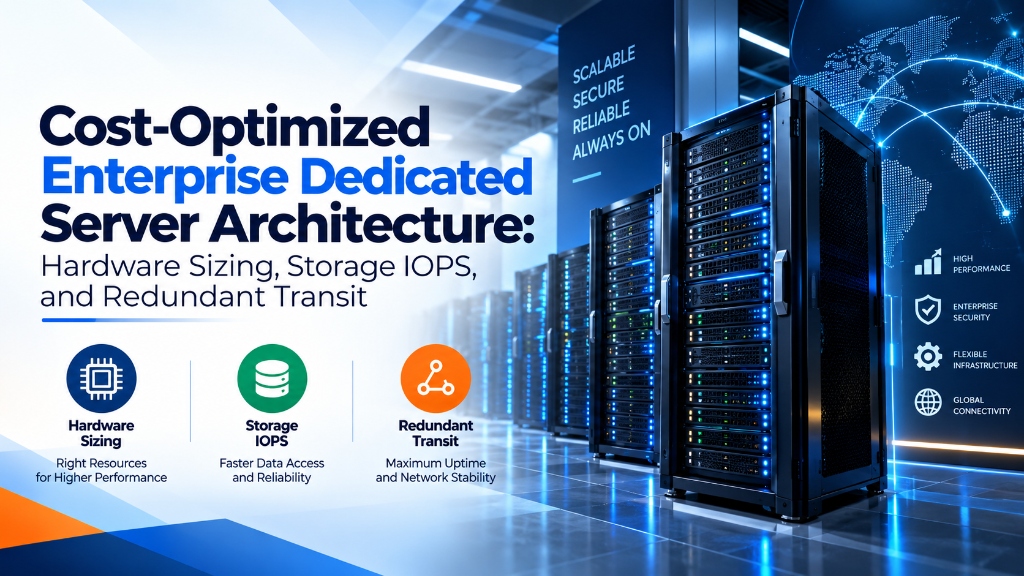
Deploying an enterprise Dedicated Server from Onlive Infotech delivers hardware-isolated computing resources, enterprise PCIe Gen4 NVMe storage arrays, and multi-gigabit Tier-1 network uplinks. It provides scalable performance, deterministic I/O throughput, and complete administrative control with 99.9% uptime SLA.
Explore our flexible VPS hosting plans for flexible virtualization.
- High-Throughput Compute: Physical core reservations with zero hypervisor contention guarantee predictable application performance.
- PCIe Gen4 NVMe Arrays: High-IOPS solid-state storage accelerates database queries, caching layers, and web application response times.
- Enterprise Network Uplinks: Redundant carrier feeds and automated DDoS filtering preserve service continuity under intense traffic spikes.
Engineering high-availability digital platforms requires striking a strategic balance between computational performance, storage scalability, and infrastructure budget efficiency. In the modern data center landscape, obtaining optimal infrastructure value does not mean purchasing discounted, obsolete hardware. Rather, true value is realized by selecting high-density bare-metal architectures that maximize compute throughput per rack unit, eliminate public cloud egress billing, and minimize power utilization overhead. Deploying an enterprise-grade dedicated server establishes dedicated hardware resources, line-rate throughput, and complete administrative sovereignty. For mission-critical single-tenant workloads, deploy our high-availability cloud server infrastructure with unshared physical compute. For organizations scaling high-throughput compute workloads, our Cheap dedicated server hosting infrastructure provides dedicated unmetered performance and enterprise hardware isolation.
Operating single-tenant bare-metal infrastructure completely eliminates the virtualization hypervisor layer. Your operating system kernel directly addresses physical processor execution pipelines, 12-channel DDR5 ECC memory buses, and PCIe Gen5 NVMe storage channels. For organizations outgrowing the resource limitations of entry-level VPS hosting or migrating from traditional web hosting configurations, dedicated server architecture provides the physical foundation necessary for continuous service availability and rigorous SLA adherence. When selecting a server administration interface, review our comprehensive Plesk vs cPanel control panel guide.
The Economics of Bare-Metal Infrastructure vs. Multi-Tenant Public Cloud
Total cost of ownership for server infrastructure encompasses physical capital, rack space, power utilization efficiency (PUE), transit commitments, and engineering operational overhead. Public cloud providers monetize compute, memory, disk IOPS, and network egress as separate billable items. When an application runs continuously at 60% or higher utilization, multi-tenant cloud instance pricing becomes substantially more expensive than dedicated bare-metal hardware.
In addition, premium data center facilities provide bulk 1Gbps and 10Gbps unmetered network ports. This connectivity model completely eliminates the risk of bandwidth bill shock during sudden viral marketing campaigns or high-volume data ingest cycles.
Consolidating multiple virtual machines onto a single high-density bare-metal platform enables organizations to reduce overall infrastructure expenditures by 40 to 65 percent while gaining complete hardware performance predictability.
Silicon Microarchitecture: Dual AMD EPYC 9004 vs. Intel Xeon Scalable
Modern bare-metal platforms deploy enterprise server processors engineered for intensive multi-threaded workloads, high cache capacities, and massive memory bandwidth. Depending on workload profiles, infrastructure engineers select between AMD EPYC 9004 series (Zen 4 microarchitecture, Genoa and Bergamo) and 4th/5th Generation Intel Xeon Scalable processors (Sapphire Rapids and Emerald Rapids).
Workloads characterized by intense parallel transaction processing—such as distributed microservices, multi-tenant databases, and queue workers—benefit significantly from AMD EPYC processors offering up to 128 physical cores and 256 execution threads per socket. Conversely, enterprise workloads requiring specialized hardware acceleration, such as Advanced Matrix Extensions (AMX) for neural inference or QuickAssist Technology (QAT) for line-rate cryptographic offloading, gain distinct performance advantages from Intel Xeon Scalable silicon.
Enterprise Hardware Sizing Matrix
| Platform Tier | CPU Configuration | Memory Subsystem | Storage Architecture | Network Uplinks | Primary Workload Profile |
|---|---|---|---|---|---|
| Compute Standard | AMD EPYC 9354P (32C/64T @ 3.25GHz) | 128GB DDR5-4800 ECC | 2x 1.92TB PCIe Gen4 NVMe | 2x 10GbE LACP Bonded | E-Commerce Portals, Redis Caching |
| Database Intensive | Dual AMD EPYC 9554 (128C/256T @ 3.10GHz) | 512GB DDR5-4800 ECC | 4x 3.84TB U.2 Enterprise NVMe | 2x 25GbE Mellanox CX-6 | High-Concurrency PostgreSQL, MySQL |
| Enterprise Flagship | Dual AMD EPYC 9654 (192C/384T @ 2.40GHz) | 1,024GB DDR5-4800 ECC | 8x 3.84TB PCIe Gen5 NVMe | 2x 25GbE Redundant SFP28 | Bare-Metal Kubernetes, Big Data |
| FinTech Accelerator | Dual Intel Xeon Platinum 8480+ (112C/224T) | 512GB DDR5-4800 ECC | 4x 1.92TB PCIe Gen5 NVMe | 2x 25GbE Ultra-Low Latency | Algorithmic Execution, Quantitative Modeling |
Storage Subsystem Architecture: Direct-Attached PCIe Gen5 NVMe
Storage performance in modern bare-metal infrastructure is powered by Non-Volatile Memory Express (NVMe) solid-state storage communicating directly over dedicated PCIe lanes. Unlike legacy SATA solid-state drives constrained by legacy AHCI controllers (limited to 32 command queues with 1 command per queue), NVMe protocols support up to 64,000 independent queues with 64,000 commands per queue. This architectural leap enables sustained random I/O performance exceeding 1,200,000 IOPS per physical drive.
Enterprise U.2 and E3.S form-factor drives incorporate onboard Power Loss Protection (PLP) capacitors. In the event of an unexpected facility power failure, PLP circuitry supplies auxiliary power to flush in-flight DRAM write buffers to non-volatile NAND flash memory. This eliminates write-hole data corruption risks during high-frequency relational database transactions.
Benchmarking Storage IOPS and Tail Latency with FIO
Storage subsystem verification requires measuring random read/write throughput and 99th-percentile completion latencies under heavy queue depths:
When executed across enterprise PCIe Gen4 or Gen5 NVMe arrays, this benchmark verifies sequential bandwidth above 6,800 MB/s and random read latencies below 25 microseconds. This low-latency storage baseline prevents database query queuing and eliminates I/O bottlenecks during peak traffic periods.
Linux Kernel Tuning for High-Concurrency Platforms
Default Linux kernel networking parameters are optimized for low-resource environments. Tuning the network stack via `/etc/sysctl.d/99-network-tuning.conf` enables the kernel to sustain hundreds of thousands of concurrent connections:
Applying these parameters via `sudo sysctl -p /etc/sysctl.d/99-network-tuning.conf` prepares the system to manage sustained high-volume HTTP/3 and WebSocket traffic without dropping connection requests or exhausting socket memory buffers. To achieve balanced multi-instance agility and cost efficiency, pair your deployment with Cheap VPS server hosting solutions featuring high-speed NVMe storage arrays.
Thermal Engineering and Power Usage Effectiveness (PUE) in Modern Data Centers
Operating bare-metal infrastructure efficiently requires strict attention to physical data center energy dynamics. Modern enterprise data centers achieve Power Usage Effectiveness (PUE) ratings between 1.10 and 1.15 through hot-aisle/cold-aisle containment, variable-speed EC fan arrays, and adiabatic free cooling systems.
Within the server chassis, dual 80 Plus Titanium power supply units (PSUs) convert 230V AC facility feeds to internal 12V DC power rails with over 96 percent efficiency. By pairing high-efficiency power distribution with dense AMD EPYC processors, modern bare-metal platforms drastically reduce electricity consumption per compute thread, allowing hosting providers to bundle unmetered high-bandwidth network ports at sustainable price points.
Storage Tiering: Direct PCIe Gen5 NVMe with Enterprise Cold Storage
High-volume web applications generate diverse data profiles: hot relational data requiring sub-millisecond access latencies, warm media assets accessed periodically, and cold archival logs requiring cost-effective long-term retention. Bare-metal servers excel at hybrid storage tiering:
Allocating high-speed NVMe partitions as secondary read caches (L2ARC) and synchronous write intent logs (SLOG) for massive SATA storage pools enables organizations to achieve petabyte-scale storage capacities while maintaining flash-tier transactional responsiveness.
Automated Bare-Metal Lifecycle Management with PXE, iPXE, and Cloud-Init
Managing bare-metal server fleets at scale does not require manual OS installations or physical data center visits. Enterprise data centers automate bare-metal lifecycle management using Preboot Execution Environment (PXE) and iPXE network booting combined with cloud-init metadata automation:
Through infrastructure-as-code orchestration frameworks such as Terraform and Ansible, systems engineers can automate the complete server lifecycle: powering on the physical chassis via IPMI/Redfish, formatting NVMe arrays with software RAID 10, bootstrapping custom kernel parameters, and deploying production container orchestration fabrics within minutes.
Bare-Metal Containerization: Kubernetes and Cilium eBPF Networking
Modern enterprise platforms deploy containerized microservices to streamline deployment pipelines and workload isolation. However, running Kubernetes clusters on top of virtualized cloud instances introduces dual-layer networking overhead: container overlay networks (such as VXLAN or Geneve) encapsulate packets that are subsequently encapsulated again by the cloud hypervisor’s virtual network fabric. This dual encapsulation increases packet processing overhead and degrades maximum transmission unit (MTU) efficiency.
Deploying Kubernetes directly onto bare-metal dedicated servers eliminates the virtualization layer. Utilizing modern Container Network Interfaces (CNI) such as Cilium powered by eBPF allows the Linux kernel to route container traffic directly across physical 25GbE interfaces using BGP host routing. Container-to-container network latency drops to single-digit microseconds, and CPU cycles previously lost to packet encapsulation are returned to application execution threads.
In addition, running container runtimes like CRI-O directly on physical hardware enables direct device plugin access. High-performance databases and machine learning microservices can bind directly to dedicated NVMe storage namespaces and hardware cryptographic accelerators, delivering true cloud-native flexibility with raw bare-metal execution speed.
Advanced Storage Architecture: OpenZFS Pools and Software RAID
Enterprise bare-metal storage architecture dictates transactional scalability. OpenZFS provides storage-level pooling, snapshotting, and data integrity verification directly within the Linux kernel:
Setting `ashift=12` optimizes I/O block alignment for 4KB physical sectors, while `lz4` compression accelerates effective read/write throughput by reducing the total volume of physical data transferred across PCIe channels.
In addition to hardware specifications, evaluating vendor SLA commitments across data center facilities is vital. Enterprise contracts must guarantee 100 percent electrical power uptime through dual-path feeds, redundant UPS battery banks, and on-site diesel turbine generators. On the physical networking layer, carrier-neutral transit with automated BGP failover across at least four Tier-1 telecom providers ensures that packet transit times remain stable regardless of external network anomalies.
Operating a dedicated bare-metal server eliminates unpredictable hypervisor throttling and noisy neighbor phenomena, providing your technical team with an agile foundation capable of sustaining millions of daily database queries and concurrent web transactions.
In addition, deploying an enterprise dedicated server gives your organization total control over kernel networking buffers, TCP socket backlog queues, and custom congestion control algorithms. By configuring Google BBR congestion control and Fair Queueing packet disciplines, your server delivers maximum line-rate throughput across high-latency international transit links with zero packet loss.
Frequently Asked Questions
Q:
Why do dedicated bare-metal servers provide superior value over public cloud?
Q:
How does 802.3ad LACP bonding ensure network resilience?
Q:
What is the operational purpose of Power Loss Protection (PLP) on enterprise NVMe drives?
Q:
What out-of-band management capabilities are provided with bare-metal servers?
Q:
How does direct NVMe storage accelerate database operations?
Infrastructure Decision Framework: Choosing Your Deployment
Balancing low latency transit, dedicated hardware isolation, and predictable operating costs ensures long-term performance stability for enterprise applications.
Deploy high-performance enterprise dedicated server solutions equipped with enterprise NVMe storage arrays, redundant network uplinks, and 24/7 expert engineering support from Onlive Infotech.
For streamlined domain management and server configuration across multi-tenant environments, refer to our comprehensive Plesk vs cPanel hosting control panel guide.
•

✓
