
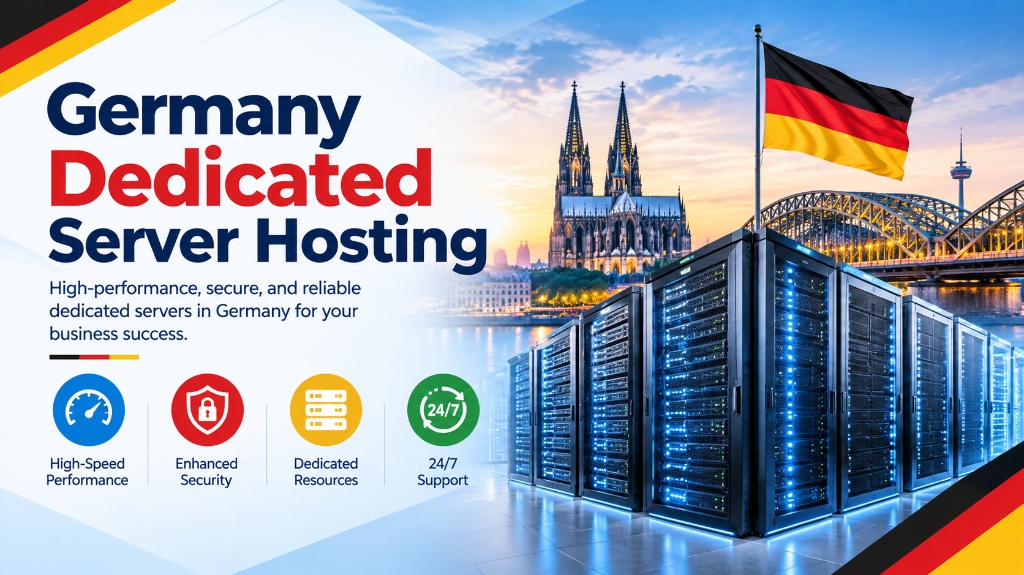
Deploying an enterprise Germany Dedicated Server in certified Frankfurt data centers delivers direct local peering via DE-CIX Frankfurt, slashing latency for domestic visitors down to sub-15ms. Powered by dedicated AMD EPYC or Intel Xeon processors, unshared ECC RAM, and PCIe Gen4 NVMe RAID arrays, it provides guaranteed computing resources, regional data compliance, and 99.9% uptime for mission-critical digital workloads. Explore our flexible VPS hosting plans for flexible virtualization.
- Low-Latency Interconnects: Direct routing through DE-CIX Frankfurt ensures deterministic response times across Germany and neighboring markets.
- Enterprise Hardware Isolation: Dedicated CPU execution threads and PCIe Gen4 NVMe arrays eliminate noisy-neighbor bottlenecks.
- Regional Compliance & Security: Localized data residency with in-line DDoS mitigation and 24/7 proactive technical operations.
Deploying high-frequency digital architectures, European fintech processing cores, and enterprise database systems demands computing environments engineered for strict German privacy laws, unshared hardware resources, and direct peering into premier continental Internet exchanges. Frankfurt am Main serves as the operational nucleus of European telecommunications, moving massive volumes of transactional data daily. When growing corporate applications run on multi-tenant cloud platforms, virtual CPU contention, noisy-neighbor memory spikes, and unpredictable storage I/O degrade performance during peak European commercial hours. Selecting an enterprise Germany dedicated server in Frankfurt gives engineering teams raw bare-metal execution, sub-1ms metro latency, and direct optical connectivity into DE-CIX Frankfurt. For mission-critical single-tenant workloads, deploy our high-availability cloud server infrastructure with unshared physical compute. For organizations scaling high-throughput compute workloads, our Germany dedicated server hosting infrastructure provides dedicated unmetered performance and enterprise hardware isolation.
Operating on physical bare metal eliminates the hypervisor abstraction layer and resource sharing common in standard VPS hosting or basic web hosting environments. With dedicated hardware, your operating system kernel interacts directly with physical AMD EPYC or Intel Xeon processors, multi-channel DDR5 ECC registered memory, and direct-attached PCIe Gen4/Gen5 NVMe solid-state drives. This raw execution model ensures stable, deterministic execution times essential for algorithmic trading platforms, e-commerce applications, and high-concurrency enterprise resource planning software. When selecting a server administration interface, review our comprehensive Plesk vs cPanel control panel guide.
Frankfurt Data Hubs, Kleyerstrasse, and DE-CIX Core Connectivity
Frankfurt’s Kleyerstrasse data corridor represents one of the most interconnected telecommunications hubs on Earth. Carrier-neutral Tier III and Tier IV facilities, such as Equinix FR5, Interxion FRA, and Digital Realty Frankfurt, provide dual-substation power feeds, N+2 cooling redundancy, and direct optical cross-connects to hundreds of global carriers. DE-CIX Frankfurt handles sustained traffic volumes exceeding 14 Terabits per second, enabling single-hop transit across Germany, Austria, Switzerland, France, the Benelux region, and Eastern Europe.
The strategic geographic positioning of Frankfurt reduces round-trip ping times across Western Europe to sub-8 milliseconds. Direct optical pathways connect server clusters to Amsterdam, London, Paris, and Zurich with minimal jitter. For multinational enterprises operating cross-border logistics, payment processing gateways, and content distribution nodes, Frankfurt-based bare-metal hosting delivers an exceptional networking foundation that insulates operations against intermediate carrier transit bottlenecks.
Central European Network Transit Latency Benchmarks
Deploying dedicated bare-metal hardware in Frankfurt datacenters delivers rapid packet transit across Germany, Western Europe, and neighboring economic centers:
| Network Destination | Average Latency (RTT) | Transit Routing Infrastructure |
|---|---|---|
| Frankfurt Metropolitan Area | < 1.2 ms | Direct DE-CIX Metro Optical Peering Fabric |
| Berlin / Munich / Hamburg | 4 – 7 ms | German National Optical Dark Fiber Backbone |
| Amsterdam (Netherlands) | 5 – 6 ms | Direct Terrestrial DWDM Expressway to AMS-IX |
| Paris (France) | 7 – 8 ms | Trans-European Terrestrial Optical Ring |
| Zurich (Switzerland) | 6 – 7 ms | Rhine Valley Express Fiber Corridor |
| London (United Kingdom) | 9 – 11 ms | Sub-channel Optical Subsea Crossing to LINX |
Hardware Architecture Profiles: German Enterprise Configurations
Germany dedicated servers are provisioned in enterprise hardware tiers designed for specific workload profiles:
| Server Tier | Processor Specification | RAM & Storage Configuration | Network Throughput | Target Workload |
|---|---|---|---|---|
| Entry Compute | Intel Xeon E-2388G (8C/16T, 3.2GHz) | 64GB DDR4 ECC, 2x 960GB NVMe RAID-1 | 1 Gbps Unmetered | Web Applications, API Gateways |
| Mid Enterprise | AMD EPYC 7543P (32C/64T, 2.8GHz) | 128GB DDR4 ECC, 2x 1.92TB NVMe RAID-1 | 10 Gbps Uplink (Bonded) | Transactional SQL Databases, SaaS |
| High-Density Compute | AMD EPYC 9354 (32C/64T, 3.25GHz) | 256GB DDR5 ECC, 4x 3.84TB NVMe RAID-10 | 10 Gbps Uplink (Bonded) | Container Clusters, Microservices |
| Dual Socket Flagship | 2x Intel Xeon Gold 6430 (64C/128T) | 512GB DDR5 ECC, 8x 3.84TB NVMe RAID-10 | 25 Gbps Redundant Fabric | Enterprise ERP, Big Data Analytics |
High-Density Processor Architectures: AMD EPYC 9004 and Intel Xeon Scalable
Modern German software engineering platforms, industrial manufacturing databases, and SAP HANA enterprise environments require immense multi-core processing power. Dedicated bare-metal servers deployed in Frankfurt feature server-grade processor microarchitectures engineered for sustained continuous computational throughput.
AMD EPYC 9004 series processors offer up to 128 physical cores and 256 threads per socket, backed by 12 DDR5 memory channels operating at 4800 MT/s. This massive memory bandwidth architecture is ideal for high-throughput container virtualization and high-concurrency databases like PostgreSQL, ClickHouse, and Redis. Intel Xeon Scalable processors feature specialized acceleration engines including Intel Advanced Matrix Extensions (AMX) for AI inference and QuickAssist Technology (QAT) for offloading SSL/TLS handshake processing.
Memory Architecture and DDR5 ECC Data Protection
Data integrity is vital when hosting financial transactions, payment systems, and sensitive European enterprise records. Dedicated servers employ registered Error-Correcting Code (ECC) DDR5 memory across multi-channel architectures. ECC memory automatically detects and corrects single-bit errors in real time, preventing memory corruption and unplanned kernel panics. Multi-channel memory configurations guarantee throughput rates exceeding 300 GB/s, enabling instant query processing across in-memory databases.
Storage Subsystems: Direct-Attached PCIe NVMe RAID Configurations
Demanding database workloads depend on sustained storage throughput and minimal read-write queue latencies. Our bare-metal configurations employ enterprise U.2 and U.3 PCIe Gen4/Gen5 NVMe solid-state drives attached directly to processor PCIe lanes. Hardware and software RAID-10 topologies combine data striping across multiple NVMe drives with mirroring, ensuring continuous data availability during physical drive failures while delivering over 1,400,000 random read IOPS and 7.2 GB/s sequential data transfers.
Linux Kernel Tuning and Network Optimization
To extract peak throughput from multi-gigabit network interfaces and high-speed NVMe storage in German datacenter deployments, administrators apply fine-tuned kernel parameters via /etc/sysctl.conf:
Enabling Google BBR congestion control alongside enlarged TCP memory windows eliminates throughput collapse across high-bandwidth international links connecting Frankfurt to Amsterdam, Paris, and Zurich.
BGP Multihoming and Low-Latency DE-CIX Peering Architecture
Maintaining high service availability across Germany and the European continent requires dynamic BGP multihoming with primary German transit providers and direct peering at DE-CIX: To achieve balanced multi-instance agility and cost efficiency, pair your deployment with Germany VPS server hosting solutions featuring high-speed NVMe storage arrays.
Automated BGP route optimization ensures that outbound traffic routes across alternative Tier-1 transit paths during terrestrial optical fiber maintenance events.
Storage Performance Benchmarking with FIO
To verify raw block storage throughput prior to deploying production databases, engineers execute rigorous synthetic benchmarks using Flexible I/O Tester:
Direct PCIe Gen4/Gen5 NVMe arrays sustain over 1,400,000 random read IOPS and 7.2 GB/s sequential throughput, eliminating disk bottlenecks for large SQL queries.
Enterprise Security Hardening and Zero-Trust Host Isolation
Securing enterprise bare-metal infrastructure requires defensive hardening at the kernel layer, network filter boundary, and application execution context. Systems engineers implement strict nftables stateful packet filtering combined with mandatory access control policies and hardened memory parameters:
Implementing kernel-level attack surface reductions, strict ingress packet sanitation, and restricted unprivileged dmesg logging prevents unauthorized binary manipulation and protects confidential cryptographic assets in server RAM.
Enterprise system administrators implement automated file integrity monitoring using tools like AIDE or Tripwire. Regular cryptographic checksum verification of core system binaries, system configuration files, and authentication databases guarantees that rootkits or unauthorized software packages are flagged immediately. To strengthen host perimeter defenses, enforcing SSH key-based authentication with elliptic-curve cryptography (Ed25519) and disabling root login over SSH completely removes vulnerability to password brute-force strikes across exposed management interfaces.
NUMA-Aware Memory Allocation and High-Density Container Tuning
Modern multi-socket bare-metal architectures operate under Non-Uniform Memory Access (NUMA) topologies where physical processor sockets manage dedicated memory controllers and DDR5 memory banks. When multi-threaded applications cross socket interconnects, latency increases. Systems engineers configure NUMA-aware core binding and page allocation to maintain low-latency memory execution:
Binding processing threads to local memory channels eliminates interconnect bus contention and delivers deterministic microsecond execution for heavy transactional workloads.
When orchestrating microservice workloads across enterprise container engines such as Docker, Podman, or Kubernetes, NUMA node topology must be passed directly into container runtime specifications. By assigning dedicated CPU sets to isolated high-performance containers, administrators guarantee that CPU caches remain hot and memory allocation requests never traverse inter-socket UPI or Infinity Fabric links during critical application transaction processing.
Out-of-Band Hardware Control with IPMI and Remote Lifecycle Management
Enterprise infrastructure operations require uninterrupted control independent of the host operating system state. Dedicated servers include integrated Baseboard Management Controllers (BMC) compliant with IPMI 2.0, Dell iDRAC, or HPE iLO standards. System administrators remotely diagnose hardware faults, modify UEFI settings, mount ISO recovery media, and power-cycle stalled kernels across dedicated management networks:
This out-of-band management capability ensures operational continuity, enabling rapid disaster recovery and remote bare-metal provisioning without physical datacenter intervention.
Frequently Asked Questions
Q: Why should my business choose Germany dedicated server hosting over public cloud instances?
Q: What bandwidth and uplink speeds are available with Frankfurt dedicated servers?
Q: How is remote server management handled without visiting the physical data center?
Q: Can I deploy custom virtualization platforms like Proxmox VE or VMware ESXi on bare metal?
Q: How does hosting in Frankfurt safeguard enterprise GDPR and data sovereignty compliance?
Infrastructure Decision Framework: Choosing Your Deployment
Balancing low latency transit, dedicated hardware isolation, and predictable operating costs ensures long-term performance stability for enterprise applications.
Deploy high-performance enterprise dedicated server solutions equipped with enterprise NVMe storage arrays, redundant network uplinks, and 24/7 expert engineering support from Onlive Infotech. For streamlined domain management and server configuration across multi-tenant environments, refer to our comprehensive Plesk vs cPanel hosting control panel guide.
 ✓
✓
