
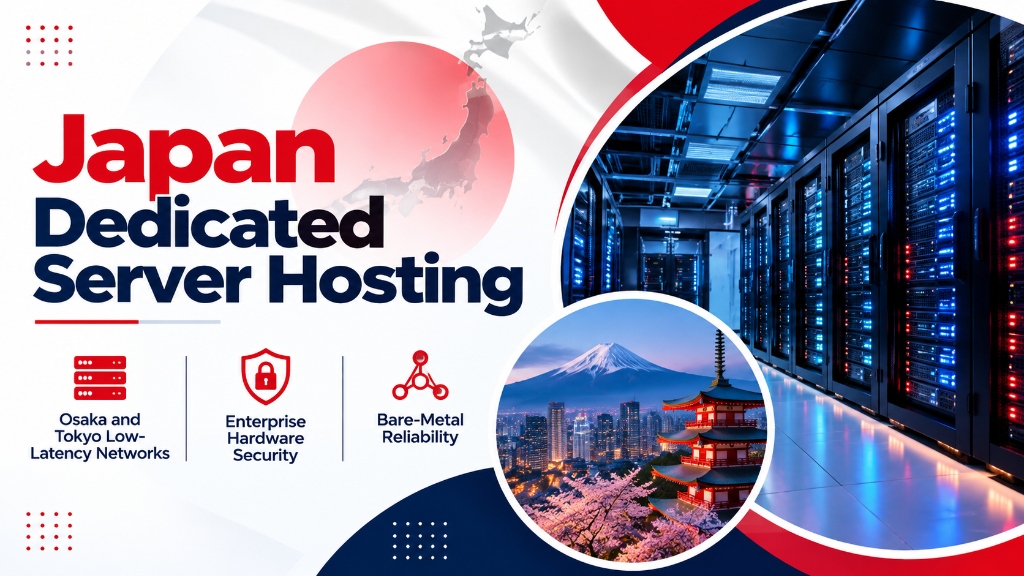
Deploying an enterprise Japan Dedicated Server in certified Tokyo & Osaka data centers delivers direct local peering via JPIX & BBIX, slashing latency for domestic visitors down to sub-15ms. Powered by dedicated AMD EPYC or Intel Xeon processors, unshared ECC RAM, and PCIe Gen4 NVMe RAID arrays, it provides guaranteed computing resources, regional data compliance, and 99.9% uptime for mission-critical digital workloads.
Explore our flexible VPS hosting plans for flexible virtualization.
- Low-Latency Interconnects: Direct routing through JPIX & BBIX ensures deterministic response times across Japan and neighboring markets.
- Enterprise Hardware Isolation: Dedicated CPU execution threads and PCIe Gen4 NVMe arrays eliminate noisy-neighbor bottlenecks.
- Regional Compliance & Security: Localized data residency with in-line DDoS mitigation and 24/7 proactive technical operations.
Deploying mission-critical digital applications across the Japanese archipelago and the broader Asia-Pacific region requires computing infrastructure engineered for extreme physical stability, high network transit speeds, and physical hardware isolation. For international gaming platforms, financial trading systems, enterprise resource planning suites, and e-commerce portals serving Japanese consumers, hosting on overseas cloud servers introduces latency spikes and compliance challenges. Selecting a Japan dedicated server in Osaka or Tokyo provides single-tenant hardware isolation, sub-10ms domestic latency, and total operational control. For mission-critical single-tenant workloads, deploy our high-availability cloud server infrastructure with unshared physical compute. For organizations scaling high-throughput compute workloads, our Japan dedicated server hosting infrastructure provides dedicated unmetered performance and enterprise hardware isolation.
Operating on bare metal eliminates the hypervisor overhead, CPU stealing, and storage I/O contention associated with shared web hosting or entry-level VPS hosting. With dedicated hardware, your operating system kernel interacts directly with high-frequency CPU cores, multi-channel DDR5 ECC memory, and direct-attached PCIe Gen4/Gen5 NVMe storage arrays, ensuring predictable execution cycles and adherence to Japan’s Act on the Protection of Personal Information (APPI). When selecting a server administration interface, review our comprehensive Plesk vs cPanel control panel guide.
Osaka and Tokyo Datacenter Ecosystems and Carrier-Neutral Peering
Japan’s digital infrastructure is anchored in the Kanto (Tokyo) and Kansai (Osaka) metropolitan corridors. While Tokyo serves as the primary national hub, Osaka provides critical geographic redundancy and disaster recovery capabilities for national telecommunications networks. Major carrier-neutral facilities—such as Equinix OS series and @Tokyo—house interconnect hubs connecting domestic networks with international subsea cable systems. These facilities link directly into the JPNAP, BBIX, and JPIX peering fabrics.
Datacenters in Osaka and Tokyo are engineered with world-class seismic resilience standards. Facility structures utilize advanced base-isolation dampers capable of absorbing major seismic shockwaves without physical component disruption. Dual independent utility feeds connect to static 2N UPS battery banks and N+1 industrial diesel backup generators with 72-hour on-site fuel reserves.
Japanese Domestic and Regional Asian Latency Benchmarks
Deploying dedicated bare-metal infrastructure in Osaka provides rapid packet transit across Japan and neighboring East Asian economies:
| Network Destination | Latency from Osaka Node | Transit Route Characteristics |
|---|---|---|
| Osaka / Kansai Metropolitan Area | 1 – 2 ms | Domestic JPNAP / BBIX Osaka Peering |
| Tokyo / Kanto Region | 7 – 9 ms | High-Speed Tokaido Dark Fiber Trunk |
| Nagoya (Chubu Region) | 4 – 6 ms | Direct Terrestrial Dark Fiber Trunk |
| Fukuoka (Kyushu Region) | 9 – 12 ms | Western Terrestrial Fiber Backbone |
| Seoul (South Korea) | 20 – 26 ms | Direct Subsea Cable (KJCN / APCN-2) |
| Taipei (Taiwan) | 30 – 36 ms | East Asian Subsea Cable System |
Compliance with Japan’s APPI Data Sovereignty Mandate
Organizations operating in Japan must comply with the Act on the Protection of Personal Information (APPI). APPI sets strict guidelines regarding data security, individual consent, and cross-border data transfers. Storing customer information on dedicated bare-metal servers within Japanese borders ensures that all sensitive records physically reside within national boundaries.
Dedicated bare-metal hardware provides clean physical boundaries, ensuring that cryptographic keys, access logs, and operating system permissions remain strictly under your organizational control without third-party hypervisor risks.
Relational Database Tuning for High-Concurrency Transactional Systems
Handling thousands of simultaneous mobile gaming queries, stock trading transactions, and e-commerce checkouts requires precise database memory allocation:
Linux Kernel Network Stack Tuning for JPNAP Transit
Optimizing TCP socket parameters ensures high-throughput packet transmission across both domestic Japanese telecom networks and regional Asian subsea fiber links:
OpenZFS Storage Mirroring and Real-Time Disk Performance Validation
Data integrity and rapid storage access are critical for mission-critical applications. Deploying OpenZFS on direct-attached enterprise NVMe drives provides cryptographic data verification and high write performance: To achieve balanced multi-instance agility and cost efficiency, pair your deployment with Japan VPS server hosting solutions featuring high-speed NVMe storage arrays.
Perimeter Security Hardening: nftables Ingress Filtering
Protecting corporate applications and database backends in Osaka requires kernel-level packet inspection. Applying an nftables ruleset blocks unauthorized reconnaissance and restricts management access to authorized subnets:
Dedicated IPMI Remote Management and Proactive Telemetry
Mission-critical deployments include dedicated IPMI 2.0 / iDRAC out-of-band management controllers supported by on-site datacenter technicians around the clock:
High-Density Processor Architectures: AMD EPYC 9004 and Dual Intel Xeon Scalable
Modern mobile gaming backends, high-frequency trading desks, and international digital media portals operating from Osaka demand high computing throughput and low inter-thread latency. Japanese dedicated servers deploy modern multi-core microprocessors designed for demanding continuous workloads.
AMD EPYC 9004 series processors deliver up to 128 physical execution cores and 256 threads per socket, supported by 12 DDR5 memory channels operating at 4800 MT/s. This high memory bandwidth architecture is optimal for compute-intensive virtualization clusters, distributed microservices, and in-memory caches like Redis. Intel Xeon Scalable processors integrate specialized hardware acceleration engines, including Intel Advanced Matrix Extensions (AMX) for machine learning workloads and Intel QuickAssist Technology (QAT) for offloading cryptographic calculations.
In-Memory Redis Caching Architecture for High-Volume Gaming Platforms
Handling thousands of simultaneous game state updates, matchmaking queries, and player inventory checks requires ultra-fast in-memory caching:
Pairing in-memory object caching with physical NVMe database storage ensures game server state updates complete in microseconds, eliminating gameplay lag for users across Japan and East Asia.
BGP Multihoming and Interconnect Redundancy Across JPNAP and BBIX
Maintaining high service availability across East Asia requires dynamic BGP multihoming across multiple carrier backbones and Japanese internet exchanges:
Dynamic BGP peering routes domestic traffic through the lowest latency paths, ensuring uninterrupted application processing across Japan.
Frequently Asked Questions
Q:
Why should an enterprise choose Osaka dedicated servers for disaster recovery?
Q:
What network port speeds and bandwidth allocations are provided on Japanese servers?
Q:
Can I install custom operating systems and hypervisors on my bare-metal server?
Q:
How does bare metal ensure security compared to shared cloud hosting?
Q:
What hardware replacement guarantees are included?
Infrastructure Decision Framework: Choosing Your Deployment
Balancing low latency transit, dedicated hardware isolation, and predictable operating costs ensures long-term performance stability for enterprise applications.
Deploy high-performance enterprise dedicated server solutions equipped with enterprise NVMe storage arrays, redundant network uplinks, and 24/7 expert engineering support from Onlive Infotech.
For streamlined domain management and server configuration across multi-tenant environments, refer to our comprehensive Plesk vs cPanel hosting control panel guide.
•

✓
