
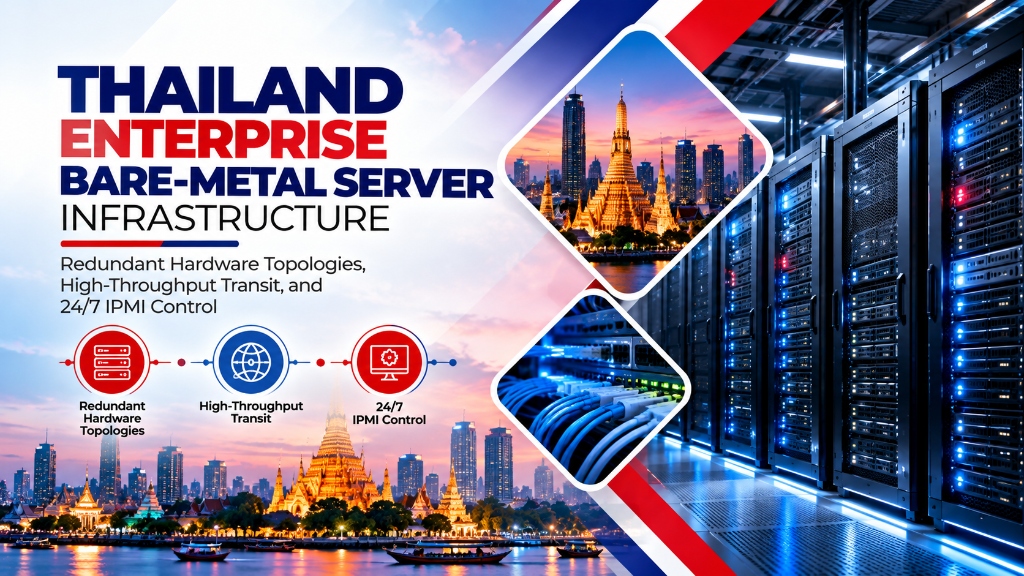
Deploying an enterprise Dedicated Server from Onlive Infotech delivers hardware-isolated computing resources, enterprise PCIe Gen4 NVMe storage arrays, and multi-gigabit Tier-1 network uplinks. It provides scalable performance, deterministic I/O throughput, and complete administrative control with 99.9% uptime SLA.
Explore our flexible VPS hosting plans for flexible virtualization.
- High-Throughput Compute: Physical core reservations with zero hypervisor contention guarantee predictable application performance.
- PCIe Gen4 NVMe Arrays: High-IOPS solid-state storage accelerates database queries, caching layers, and web application response times.
- Enterprise Network Uplinks: Redundant carrier feeds and automated DDoS filtering preserve service continuity under intense traffic spikes.
Operating critical digital applications across Thailand and Southeast Asian commercial territories requires resilient server architecture, deterministic hardware performance, and comprehensive network availability. When managing high-volume transactional databases, enterprise enterprise resource planning (ERP) systems, gaming backend platforms, and localized content delivery clusters, virtualized cloud infrastructure often suffers from noisy neighbor interference and erratic storage latency. Virtual machine instances compete for shared hypervisor CPU cores and physical memory bandwidth, resulting in performance degradation during peak traffic hours. Provisioning an enterprise dedicated server in Bangkok delivers single-tenant bare-metal isolation, high-density computing capacity, and low-latency peering across regional telecom backbones. For mission-critical single-tenant workloads, deploy our high-availability cloud server infrastructure with unshared physical compute. For organizations scaling high-throughput compute workloads, our Cheap dedicated server hosting infrastructure provides dedicated unmetered performance and enterprise hardware isolation.
Bare-metal dedicated hardware bypasses hypervisor resource scheduling entirely. Your operating system kernel has dedicated access to physical processor execution pipelines, multi-channel DDR5 ECC memory buses, and high-speed PCIe Gen5 NVMe storage channels. Organizations outgrowing shared web hosting plans or needing greater hardware control than standard VPS hosting platforms can provide benefit from single-tenant dedicated servers that deliver uninterrupted performance and high service availability. When selecting a server administration interface, review our comprehensive Plesk vs cPanel control panel guide.
Bangkok Tier-III Datacenter Infrastructure and Regional Telecommunications
Modern enterprise bare-metal infrastructure in Thailand is housed in certified Tier-III carrier-neutral facilities located within the Bangkok metropolitan area. These datacenters feature 2N electrical distribution feeds, automated diesel backup generators, N+1 precision cooling infrastructure, and biometric security controls. Network connectivity is engineered with multi-homed BGP routing connected directly to Tier-1 upstream transit providers and local peering exchanges.
The Bangkok Neutral Internet Exchange (BKNIX) serves as the primary domestic peering exchange. Interconnecting directly with BKNIX enables traffic to exchange locally with major domestic Internet Service Providers—such as AIS, True Corporation / dtac, and National Telecom (NT)—without routing through foreign international transit gateways. Network latency within Bangkok registers under 2 milliseconds, transit across major industrial provinces remains below 10 milliseconds, and regional links to Singapore and Malaysia operate under 28 milliseconds.
Compute Engineering: AMD EPYC 9004 and Intel Xeon Scalable
Modern enterprise bare-metal servers deploy high-density compute architectures engineered specifically for continuous enterprise duty cycles. Depending on the operational profile of your enterprise software, systems are equipped with AMD EPYC 9004 series processors or 4th/5th Generation Intel Xeon Scalable processors.
AMD EPYC processors deliver up to 128 physical execution cores and 256 processing threads per socket, supported by 12 DDR5 memory channels operating at 4800 MT/s. This high memory bandwidth architecture is optimal for compute-intensive virtualization clusters, distributed microservices, and in-memory analytical caches like Redis and Valkey. Intel Xeon Scalable processors integrate specialized hardware acceleration engines, including Intel Advanced Matrix Extensions (AMX) for deep learning workloads and Intel QuickAssist Technology (QAT) for offloading cryptographic hashing, SSL/TLS handshakes, and disk compression algorithms directly from the CPU core.
Storage Subsystems: Enterprise PCIe Gen5 NVMe Arrays vs Virtual Disks
Virtual cloud storage platforms rely on multi-tenant network fabric abstraction layers that introduce I/O latency spikes and strict IOPS limits. In contrast, bare-metal servers connect enterprise U.2/U.3 NVMe solid-state storage drives directly to processor PCIe 5.0 lanes.
| Architectural Dimension | Shared / VPS Hosting | Thailand Enterprise Bare-Metal Server |
|---|---|---|
| CPU Resource Allocation | Virtual cores with contention | 100% Dedicated physical cores & cache |
| Memory Architecture | Dynamically allocated virtual RAM | Dedicated multi-channel DDR5 ECC RAM |
| Storage Bus & Throughput | Rate-limited virtual disk pools | Direct PCIe 5.0 NVMe (up to 14 GB/s) |
| Network Uplink Capacity | Shared switch port with throttling | Dedicated 10GbE / 25GbE bonded ports |
| Out-of-Band Management | Restricted control panel console | Hardware IPMI 2.0 / iDRAC / iLO with KVM |
| Data Privacy Compliance | Shared multi-tenant risk | Thailand PDPA Statutory Compliance |
High-Performance Storage Benchmarking with FIO
Validating raw disk performance is an essential operational procedure upon provisioning bare-metal hardware. Enterprise NVMe solid-state storage includes dedicated power loss protection (PLP) capacitors, enabling synchronous writes to commit to disk without data corruption risks. You can verify random read and write capabilities using the Flexible I/O Tester (fio):
Enterprise NVMe hardware in Bangkok datacenters routinely outputs over 1.2 million random read IOPS and sub-20 microsecond access latencies, outperforming cloud-attached storage tiers by an order of magnitude.
Linux Kernel Network Optimization for High-Concurrency Services
To extract peak throughput from 10GbE or 25GbE network interfaces, administrators must configure Linux kernel socket buffers, connection backlogs, and congestion control parameters. The default Linux networking settings are tailored for standard desktop or low-traffic environments and throttle high-frequency traffic streams.
The following production configuration applies Google BBR (Bottleneck Bandwidth and Round-trip propagation time) congestion control and expands TCP memory windows:
Activating BBR prevents packet drops on trans-continental and regional peering lines, sustaining peak line-rate transmission even when network buffers experience transient micro-burst congestion. To achieve balanced multi-instance agility and cost efficiency, pair your deployment with Cheap VPS server hosting solutions featuring high-speed NVMe storage arrays.
High Availability Networking: 802.3ad LACP Interface Bonding
Enterprise bare-metal configurations are equipped with redundant physical network interfaces wired to independent upstream switch chassis. By combining dual interfaces into a single logical bond using the IEEE 802.3ad Link Aggregation Control Protocol (LACP), your server doubles total usable throughput while eliminating single points of network hardware failure.
With LACP bonding enabled, if an individual physical fiber transceiver or switch module encounters a hardware fault, traffic fails over to the alternate interface in less than 100 milliseconds without dropping active TCP connections.
Out-of-Band Hardware Management: IPMI 2.0 and Redfish
Complete administrative autonomy is essential for mission-critical operations. Every enterprise bare-metal server includes an isolated Baseboard Management Controller (BMC) accessible via IPMI 2.0, Dell iDRAC, or HP iLO over a dedicated out-of-band management network. This hardware interface operates independently of the primary CPU and host operating system.
Through out-of-band management, your engineering team can perform cold reboots, mount recovery ISO images, adjust motherboard BIOS parameters, and resolve operating system bootloader issues remotely without requiring on-site datacenter technician intervention.
Compliance Governance: Thailand Personal Data Protection Act (PDPA)
Deploying digital infrastructure in Thailand requires compliance with the Personal Data Protection Act (PDPA B.E. 2562). The law establishes strict controls over how data controllers collect, process, and store personal identifiers, imposing heavy financial penalties for cross-border data transfer violations.
Hosting enterprise workloads on physical dedicated servers within certified Bangkok datacenters guarantees that personal data stays inside Thailand’s borders. Hardware encryption using LUKS2 backed by hardware TPM 2.0 modules safeguards databases against unauthorized drive access, fully aligning with the regulatory mandates set forth by the Personal Data Protection Committee (PDPC).
Enterprise Security Hardening with Nftables
Securing bare-metal network ingress requires deterministic packet filtering. Replacing legacy iptables with modern nftables enables stateful connection inspection and atomic rule compilation with negligible CPU overhead:
Deploying tailored nftables rule sets directly on bare-metal hardware shields internal application runtimes against unauthorized reconnaissance and distributed connection flood attacks.
Electrical Redundancy and Power Infrastructure: 2N Power Feeds
Continuous service availability in tropical datacenters depends heavily on uninterrupted power delivery and precision cooling. Enterprise bare-metal servers in Bangkok are outfitted with dual hot-swappable Platinum-grade power supply units (PSUs). Each PSU connects to a distinct power distribution unit (PDU) powered by independent substation feeds and uninterruptible power supply (UPS) battery banks:
This electrical architecture ensures that if a power grid fluctuation or PDU breaker trip occurs, the secondary power supply instantaneously maintains server operations without voltage sag or hardware reset.
Real-Time Hardware Telemetry via Prometheus and Grafana
Managing bare-metal infrastructure requires continuous telemetry collection. Deploying Prometheus Node Exporter allows engineering teams to monitor CPU core temperatures, DDR5 ECC memory errors, and NVMe wear levels in real time. Threshold alerts ensure proactive replacement of storage media or fans before unexpected downtime occurs.
Frequently Asked Questions
Q:
Why deploy a dedicated bare-metal server in Thailand?
Q:
How does BKNIX direct peering improve network latency?
Q:
What out-of-band management tools are provided with bare-metal servers?
Q:
How does LACP network bonding prevent single points of network failure?
Q:
How do enterprise NVMe SSDs safeguard database integrity during power loss?
Infrastructure Decision Framework: Choosing Your Deployment
Balancing low latency transit, dedicated hardware isolation, and predictable operating costs ensures long-term performance stability for enterprise applications.
Deploy high-performance enterprise dedicated server solutions equipped with enterprise NVMe storage arrays, redundant network uplinks, and 24/7 expert engineering support from Onlive Infotech.
For streamlined domain management and server configuration across multi-tenant environments, refer to our comprehensive Plesk vs cPanel hosting control panel guide.
•

✓
