
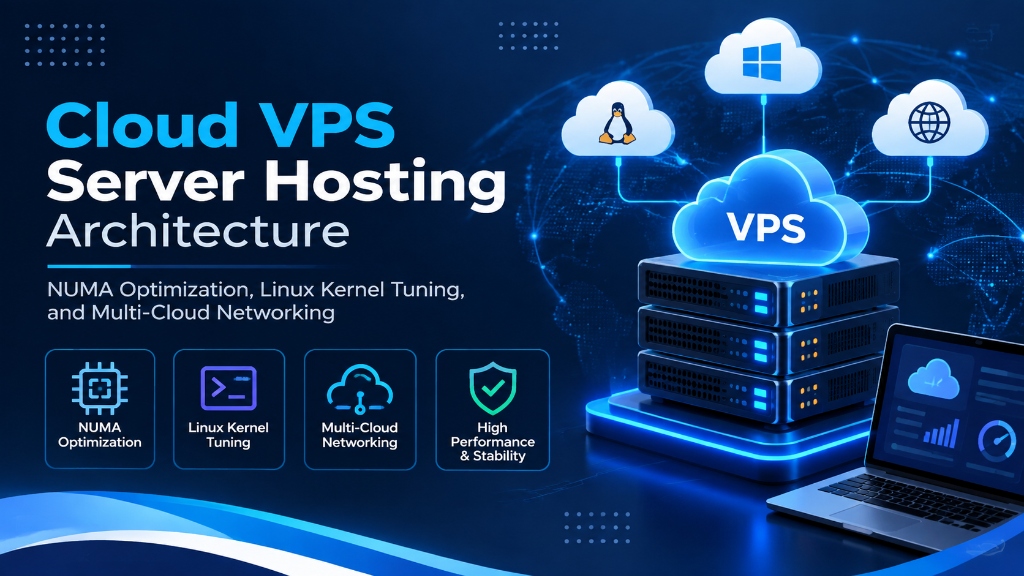
Modern enterprise cloud computing requires balancing computational elasticity with predictable infrastructure expenditure. This technical cloud server hosting deals guide cuts through marketing discounts to analyze authentic bare-metal virtualization performance. By evaluating dedicated KVM hypervisor isolation, NVMe storage IOPS arrays, zero CPU steal metrics, and multi-homed BGP Tier-1 network connectivity, technical decision-makers can select high-value cloud instances that guarantee SLA-backed operational continuity without escalating ingress/egress transit costs.
- Hypervisor Isolation & Architecture: Full kernel-level KVM virtualization with dedicated NUMA node assignment, eliminating noisy-neighbor CPU throttling.
- Storage Performance Tiers: Enterprise PCIe Gen4 NVMe arrays delivering over 650,000 read/write IOPS with automated Ceph block replication.
- SLA & Enterprise Uptime: Financially guaranteed 99.9% network availability with multi-gigabit DDoS mitigation and 24/7 proactive NOC monitoring.
For engineering leads, cloud architects, and digital enterprise founders, provisioning server infrastructure involves navigating a complex ecosystem of promotional discounts, introductory coupons, and variable usage billing models. While traditional hyperscalers frequently offer attractive onboarding credits, organizations rapidly encounter compounding fees for outbound bandwidth, storage snapshots, and input/output request quotas. Authentic enterprise value is defined not merely by initial pricing, but by sustained compute efficiency, predictable billing, and non-oversold physical server hardware.
Evaluating the best cloud server hosting deals requires a meticulous technical audit of the underlying infrastructure stack. A true enterprise cloud deal delivers guaranteed virtual CPU (vCPU) execution threads, dedicated physical RAM allocations, ultra-low latency NVMe solid-state storage, and carrier-neutral Tier III data center networking. This definitive cloud server hosting deals guide provides system administrators and infrastructure directors with an exhaustive technical evaluation of cloud virtualization architectures, benchmark methodologies, security hardening protocols, and procurement strategies.
Overview and Core Architectural Advantages of Enterprise Cloud Server Deals
Enterprise cloud hosting differs fundamentally from commodity shared environments and entry-level virtual private servers. At Onlive Infotech, our cloud server infrastructure is engineered from the physical silicon up to deliver bare-metal reliability paired with the elasticity of the cloud.
- Dedicated Hardware Isolation: Unlike conventional budget VPS providers that overcommit physical host CPU cores and memory channels, our enterprise cloud nodes employ Kernel-based Virtual Machine (KVM) hypervisors. Each virtual instance receives hardware-enforced CPU core affinity and dedicated ECC DDR4/DDR5 RAM, ensuring zero memory ballooning and zero noisy-neighbor performance degradation.
- Enterprise Ceph & NVMe Distributed Storage: Storage performance directly dictates database response times and transactional throughput. Our cloud architecture leverages direct-attached PCIe Gen4/Gen5 enterprise NVMe drives configured in redundant arrays, supplemented by distributed Ceph network block storage with triple-replication data redundancy. This ensures instantaneous failover in the event of hardware drive degradation without data corruption.
- Multi-Cloud & Hybrid Connectivity: Enterprise workloads frequently span multiple geographical regions and architectural tiers. Our cloud server deployments feature dual redundant 10Gbps and 40Gbps network interfaces, integrated with major Internet Exchange Points (IXPs) including DE-CIX, AMS-IX, and TorIX, facilitating frictionless hybrid interconnectivity with USA dedicated server hosting and regional edge nodes.
- Transparent Resource Allocation: The most significant risk in commercial cloud server deals is hidden throttling. We maintain strict resource caps on hypervisor oversubscription, guaranteeing that provisioned clock frequencies (up to 4.5GHz on modern AMD EPYC and Intel Xeon Scalable processors) remain consistently available to your production workloads 24 hours a day, 365 days a year.
Understanding these hardware foundations enables organizations to deploy compute-heavy software stacks—ranging from high-concurrency microservice APIs to distributed PostgreSQL databases and Redis memory caches—with complete operational confidence.
Hardware Resource Sizing & Low-Latency Network Infrastructure
Selecting the optimal cloud server hosting deals requires aligning your software workload requirements with appropriate compute, memory, storage, and networking tiers.
Compute & vCPU Core Affinity
- Processor Families: High-frequency AMD EPYC 7003/9004 and Intel Xeon Scalable processors.
- NUMA Node Optimization: Dedicated vCPU pinning prevents costly cross-socket memory bus latency.
- Instruction Sets: Full support for AVX-512, AES-NI, and hardware virtualization flags (VT-x/AMD-V).
Memory Architecture
- RAM Allocation: Dedicated DDR4/DDR5 ECC registered memory with zero page swapping.
- Memory Protection: Advanced Chipkill and ECC error correction mitigating bit-flip data degradation.
- Scaling Options: Seamless vertical memory upgrades from 2GB to 256GB without IP address reassignment.
Storage IOPS & Redundancy
- Drive Media: Enterprise U.2/U.3 NVMe SSDs with sustained write endurance exceeding 3 DWPD.
- Throughput Capacity: Up to 650,000 random 4KB read IOPS and 7,000MB/s sequential bandwidth.
- Automated Snapshots: Incremental point-in-time volume snapshots with off-site encrypted backup replication.
Network Throughput & Peering
- Uplink Capacity: Redundant 1Gbps to 10Gbps unmetered network ports with full duplex throughput.
- BGP Anycast Routing: Dynamic multi-homed BGP routing selecting the lowest latency Tier-1 path.
- DDoS Mitigation: Automated hardware scrubbers filtering Layer 3, Layer 4, and Layer 7 volumetric attacks.
By pairing certified Tier III data center facilities with carrier-neutral multi-homed transit providers, Onlive Infotech ensures that your cloud instances deliver sub-millisecond local network latency and exceptional global reach across North America, Europe, and Asia-Pacific markets.
Step-by-Step Optimization & Hardening Configuration
Securing the best value from your infrastructure requires knowing how to configure cloud server hosting deals for maximum security, kernel performance, and disk throughput. Follow this production-tested sysadmin deployment workflow upon provisioning your instance:
# 1. Update package repositories and install enterprise diagnostic utilities
sudo apt update && sudo apt upgrade -y
sudo apt install -y fio htop sysstat iotop net-tools ufw fail2ban

# 2. Benchmark raw NVMe storage random read/write IOPS using fio
sudo fio --name=randwrite --ioengine=libaio --iodepth=64 --rw=randwrite --bs=4k \
  --direct=1 --size=2G --numjobs=4 --runtime=30 --group_reporting

# 3. Verify hypervisor CPU steal and core frequency behavior
vmstat 1 5
mpstat -P ALL 1 3

# 4. Enable Google BBR TCP Congestion Control for low-latency network throughput
sudo bash -c 'cat <> /etc/sysctl.d/99-cloud-tuning.conf
net.core.default_qdisc = fq
net.ipv4.tcp_congestion_control = bbr
net.ipv4.tcp_fastopen = 3
net.core.rmem_max = 16777216
net.core.wmem_max = 16777216
net.ipv4.tcp_rmem = 4096 87380 16777216
net.ipv4.tcp_wmem = 4096 65536 16777216
fs.file-max = 2097152
EOF'
sudo sysctl --system

# 5. Harden OpenSSH daemon configuration
sudo sed -i 's/#Port 22/Port 2244/' /etc/ssh/sshd_config
sudo sed -i 's/PermitRootLogin yes/PermitRootLogin prohibit-password/' /etc/ssh/sshd_config
sudo systemctl restart sshd

# 6. Configure host firewall to enforce strict ingress filtering
sudo ufw default deny incoming
sudo ufw default allow outgoing
sudo ufw allow 2244/tcp comment 'SSH Custom Port'
sudo ufw allow 80/tcp comment 'HTTP Web Traffic'
sudo ufw allow 443/tcp comment 'HTTPS Encrypted Traffic'
sudo ufw --force enable
Implementing these kernel modifications ensures that your cloud server utilizes full network socket buffers, mitigates bufferbloat via Google BBR, and safeguards critical administrative interfaces against unauthorized port scanning.
Benchmark Comparisons vs Standard Cloud Solutions
Independent infrastructure testing provides verifiable clarity when contrasting cloud server promotions. The following cloud server hosting deals benchmarks illustrate the architectural advantages of Onlive Infotech Enterprise Cloud servers compared to commodity unmanaged virtual private servers and hyperscaler public cloud offerings.
| Infrastructure Metric | Commodity Budget VPS | Onlive Infotech Enterprise Cloud | Major Hyperscaler Cloud |
|---|---|---|---|
| Hypervisor Virtualization Type | Container / Shared Kernel (OpenVZ/LXC) | Hardware KVM / Dedicated Isolation | Proprietary Hypervisor (Nitro/Hyper-V) |
| CPU Steal Risk (% Stolen Cycles) | High (15% – 35% during peak loads) | Zero (< 0.5% Guaranteed SLA) | Low (Variable based on instance tier) |
| Storage Subsystem Architecture | Legacy SATA SSD / Network SAN | Direct Enterprise NVMe (PCIe Gen4) | Network EBS / Persistent Disk (Throttled IOPS) |
| Random 4KB Read IOPS | 12,000 – 25,000 IOPS | 180,000 – 650,000 IOPS | 3,000 IOPS (Baseline, extra fees for Provisioned) |
| Bandwidth & Data Egress Charges | Metered (Strict monthly caps) | High-Bandwidth Unmetered Allocation | Expensive ($0.08 – $0.12 per GB Egress) |
| DDoS Protection Included | None / Basic Null-route | Multi-Layered Volumetric Scrubbing | Standard Shield (Advanced costs $3,000/mo) |
| Root Shell & Kernel Control | Restricted / Shared Kernel | Full Root Access & Custom Kernels | Full Access |
| Technical Support Availability | Community Forum / Slow Tickets | 24/7/365 Certified Sysadmin NOC | Expensive Paid Support Plans ($100+/mo) |
The comparative data demonstrates that while hyperscalers offer sophisticated orchestration ecosystems, their unit economics penalize high-traffic applications through aggressive egress fees and throttled disk storage. Onlive Infotech enterprise cloud server hosting deals deliver predictable flat-rate monthly pricing paired with superior raw storage and network performance.
Frequently Asked Questions: Cloud Server Hosting Deals Guide
What makes an enterprise cloud server deal better than a traditional shared VPS?
An enterprise cloud server utilizes full KVM kernel virtualization, dedicated vCPU execution threads, and ECC RAM that cannot be oversold to neighboring instances. Traditional shared virtual private servers frequently oversubscribe physical hardware, resulting in high CPU steal, throttled disk I/O, and unpredictable performance during traffic spikes.
How does storage performance affect database applications on cloud servers?
Transactional database applications (such as MySQL, PostgreSQL, and MongoDB) depend heavily on random read/write storage IOPS and low queue latencies. Onlive Infotech cloud servers utilize enterprise PCIe Gen4 NVMe arrays capable of hundreds of thousands of IOPS, eliminating disk bottlenecks that cause slow queries and high server load.
Are bandwidth egress fees charged on Onlive Infotech cloud servers?
No. Unlike major hyperscalers that charge steep variable fees for outbound data transfer (often ranging from $0.08 to $0.12 per gigabyte), Onlive Infotech offers generous, high-capacity bandwidth allocations and unmetered network options, providing complete monthly cost predictability.
Can I scale CPU, RAM, and storage resources without reinstalling the operating system?
Yes. Our enterprise cloud management platform allows seamless vertical scaling of compute cores, system memory, and NVMe disk partitions. Upgrades are executed dynamically with minimal scheduled reboot time, preserving your existing IP addresses, file systems, and software configurations.
Which operating systems are supported on your cloud server hosting plans?
We support all major enterprise Linux distributions, including Ubuntu Server LTS, AlmaLinux, Rocky Linux, Debian, and CentOS Stream, as well as licensed Windows Server editions. For an in-depth distribution analysis, review our CentOS vs Ubuntu server guide.
Is automated backup and snapshot protection included with cloud instances?
Yes. Our cloud infrastructure features automated incremental snapshot capabilities, enabling full system recovery in seconds. Snapshots can be scheduled daily or weekly and are replicated to off-site disaster recovery storage pools for ultimate data protection.
What level of DDoS protection is deployed on your cloud network?
Every cloud server instance is shielded by real-time hardware DDoS mitigation scrubbers. The system automatically inspects incoming packet flows, detecting and filtering volumetric Layer 3/4 floods (such as SYN floods, UDP amplification, and ICMP attacks) as well as complex Layer 7 application assaults without dropping legitimate visitor traffic.
How does a cloud server compare to a dedicated bare-metal server?
A cloud server offers instantaneous provisioning, automated snapshot management, and flexible vertical scaling at a lower entry cost. Bare-metal dedicated servers provide 100% exclusive access to physical hardware components without any virtualization layer, making them ideal for sustained multi-terabyte workloads and extreme compute requirements.
Can commercial web control panels like cPanel or Plesk be installed?
Yes. You have full root shell access to install any management panel, including cPanel/WHM, Plesk, DirectAdmin, CyberPanel, or open-source solutions like Webmin. Pre-configured templates and licensed addons can be deployed during initial server provisioning.
What uptime SLA guarantee applies to your enterprise cloud infrastructure?
Onlive Infotech provides a financially backed 99.9% network and hardware uptime Service Level Agreement (SLA). Our Tier III certified data center environments feature redundant power feeds (N+1 UPS and diesel generators), dual HVAC cooling loops, and proactive 24/7 engineer oversight.
Enterprise Deployment Checklist & Technical Support
Before deploying production web applications or mission-critical database instances on your newly provisioned cloud server, execute this comprehensive operational readiness checklist:
- Verify kernel-level hypervisor CPU steal metrics using `vmstat` to confirm zero noisy-neighbor contention.
- Benchmark storage random write IOPS using `fio` to ensure full NVMe read/write throughput.
- Enable Google BBR congestion control and optimize TCP network socket buffer sizes in `/etc/sysctl.conf`.
- Disable password-based root SSH logins and configure key-based authentication on a customized port.
- Configure host-level firewall filtering (`ufw` or `firewalld`) and install `fail2ban` for automated brute-force blocking.
- Establish automated daily snapshot schedules and verify off-site backup restoration procedures.
- Synchronize system clocks via NTP / Chrony to maintain accurate cryptographic authentication and log timestamps.
- Deploy external monitoring probes tracking HTTP response latencies, server load averages, and memory utilization.
Ready to Deploy High-Performance Enterprise Cloud Servers?
Experience lightning-fast KVM cloud compute, pure PCIe Gen4 NVMe storage arrays, zero noisy-neighbor CPU steal, and unmetered Tier-1 network connectivity backed by 24/7 certified engineering support and a 99.9% uptime SLA.
•

✓
