
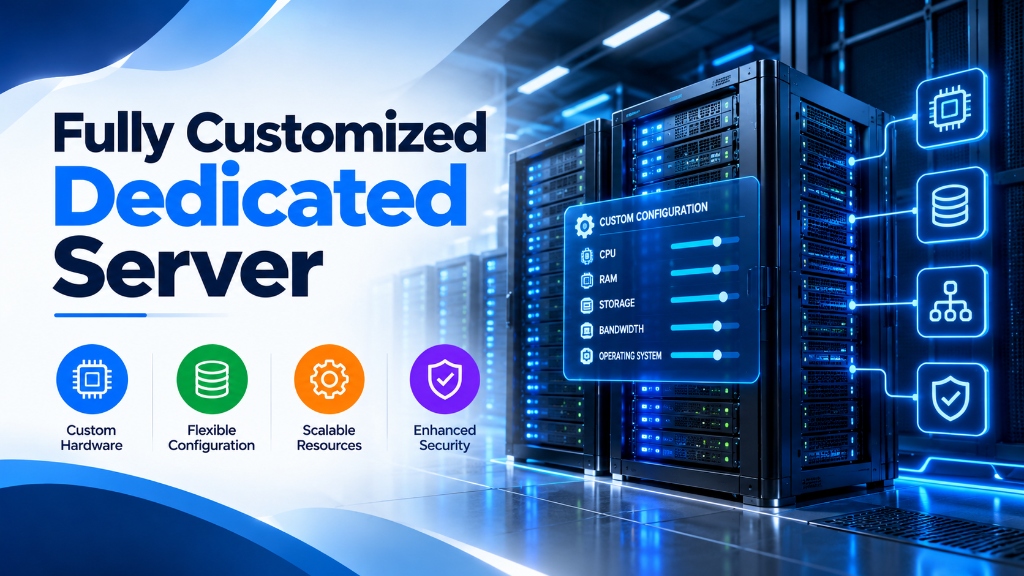
Deploying an enterprise Dedicated Server from Onlive Infotech delivers hardware-isolated computing resources, enterprise PCIe Gen4 NVMe storage arrays, and multi-gigabit Tier-1 network uplinks. It provides scalable performance, deterministic I/O throughput, and complete administrative control with 99.9% uptime SLA.
Explore our flexible VPS hosting plans for flexible virtualization.
- High-Throughput Compute: Physical core reservations with zero hypervisor contention guarantee predictable application performance.
- PCIe Gen4 NVMe Arrays: High-IOPS solid-state storage accelerates database queries, caching layers, and web application response times.
- Enterprise Network Uplinks: Redundant carrier feeds and automated DDoS filtering preserve service continuity under intense traffic spikes.
Modern enterprise computing workloads rarely fit cleanly into rigid, standardized virtual machine templates. High-volume transactional databases, real-time telemetry processing engines, machine learning model inference pipelines, and distributed streaming architectures each impose unique, highly specific hardware requirements. While some workloads demand massive single-thread CPU clock speeds, others require extreme multi-core parallelism, massive DDR5 memory bandwidth, or petabyte-scale NVMe storage fabrics. Deploying a tailored bare-metal environment through an enterprise dedicated server grants infrastructure architects the freedom to customize every layer of physical and logical infrastructure, from BIOS power states and PCIe lane bifurcation to custom Linux kernel compilation. For mission-critical single-tenant workloads, deploy our high-availability cloud server infrastructure with unshared physical compute. For organizations scaling high-throughput compute workloads, our Cheap dedicated server hosting infrastructure provides dedicated unmetered performance and enterprise hardware isolation.
Operating a dedicated bare-metal server completely eliminates the virtualization hypervisor layer. Your operating system kernel directly addresses physical processor execution pipelines, 12-channel DDR5 ECC memory buses, and PCIe Gen5 NVMe storage channels. For organizations outgrowing the resource limitations of entry-level VPS hosting or migrating from traditional web hosting configurations, dedicated server architecture provides the physical foundation necessary for continuous service availability and rigorous SLA adherence. When selecting a server administration interface, review our comprehensive Plesk vs cPanel control panel guide.
Silicon Microarchitecture: Selecting and Tailoring Compute Engines
Modern bare-metal platforms deploy enterprise server processors engineered for intensive multi-threaded workloads, high cache capacities, and massive memory bandwidth. Depending on workload profiles, infrastructure engineers select between AMD EPYC 9004 series (Zen 4 microarchitecture, Genoa and Bergamo) and 4th/5th Generation Intel Xeon Scalable processors (Sapphire Rapids and Emerald Rapids).
Workloads characterized by intense parallel transaction processing—such as distributed microservices, multi-tenant databases, and queue workers—benefit significantly from AMD EPYC processors offering up to 128 physical cores and 256 execution threads per socket. Conversely, enterprise workloads requiring specialized hardware acceleration, such as Advanced Matrix Extensions (AMX) for neural inference or QuickAssist Technology (QAT) for line-rate cryptographic offloading, gain distinct performance advantages from Intel Xeon Scalable silicon.
Custom Hardware Sizing Comparison Matrix
| Workload Architecture | CPU Microarchitecture | Memory Subsystem | Storage Bus Configuration | Network Uplinks | Target Use Case |
|---|---|---|---|---|---|
| Low-Latency Financial | Intel Xeon Gold 6444Y (16C @ 4.0GHz) | 128GB DDR5-4800 Low-CAS | 2x 1.92TB PCIe Gen5 NVMe | 2x 25GbE Solarflare / Mellanox | Algorithmic Order Execution |
| Relational DB Cluster | Dual AMD EPYC 9354 (64C/128T) | 512GB DDR5-4800 ECC | 4x 3.84TB U.2 NVMe RAID 10 | 2x 25GbE LACP Active-Active | High-Concurrency PostgreSQL |
| High-Density Compute | Dual AMD EPYC 9654 (192C/384T) | 1,024GB DDR5-4800 ECC | 8x 3.84TB PCIe Gen5 NVMe | 2x 25GbE Redundant SFP28 | Bare-Metal Kubernetes, AI |
| Unmetered Media Node | Intel Xeon Gold 6430 (32C/64T) | 128GB DDR5-4800 ECC | 2x NVMe Boot + 4x 16TB SATA | 10Gbps Dedicated Unmetered | Video Streaming, Static CDN |
PCIe Lane Bifurcation and Direct-Attached NVMe Storage Layouts
Storage performance in modern bare-metal infrastructure is powered by Non-Volatile Memory Express (NVMe) solid-state storage communicating directly over dedicated PCIe lanes. Unlike legacy SATA solid-state drives constrained by legacy AHCI controllers (limited to 32 command queues with 1 command per queue), NVMe protocols support up to 64,000 independent queues with 64,000 commands per queue. This architectural leap enables sustained random I/O performance exceeding 1,200,000 IOPS per physical drive.
Enterprise motherboards support PCIe lane bifurcation, allowing a single 16-lane PCIe slot to split electronically into x4/x4/x4/x4 configurations. This allows high-density drive enclosures to connect multiple U.2 or E3.S enterprise NVMe drives directly to CPU root complexes without relying on bottleneck-inducing PCIe switch chips or proprietary hardware RAID cards.
Benchmarking Storage IOPS and Tail Latency with FIO
Storage subsystem verification requires measuring random read/write throughput and 99th-percentile completion latencies under heavy queue depths:
When executed across enterprise PCIe Gen4 or Gen5 NVMe arrays, this benchmark verifies sequential bandwidth above 6,800 MB/s and random read latencies below 25 microseconds. This low-latency storage baseline prevents database query queuing and eliminates I/O bottlenecks during peak traffic periods.
Compiling and Customizing the Linux Kernel for Low-Latency Workloads
Standard Linux distribution kernels are compiled with generic preemption and desktop-oriented scheduling to support broad consumer hardware. On dedicated bare-metal enterprise servers, administrators compile streamlined custom kernels tailored directly to the server’s specific CPU microarchitecture and workload profile:
Compiling with `CONFIG_NO_HZ_FULL` and processor-specific instruction sets eliminates timer interrupt interrupts on worker CPU cores, ensuring that execution threads run continuously without periodic kernel scheduler interruptions.
Network Redundancy: 802.3ad LACP High Availability
Mission-critical infrastructure deployments require physical network redundancy. Servers connect to independent top-of-rack switches through dual 10GbE or 25GbE physical interfaces configured in an active-active 802.3ad Link Aggregation Control Protocol (LACP) bond:
Enforcing `transmit-hash-policy: layer3+4` balances outgoing IP packets across both physical interfaces based on IP and TCP/UDP port hashes. If an upstream switch port or fiber patch cable experiences a fault, traffic fails over within milliseconds without terminating active TCP connections.
Linux Kernel Tuning for High-Concurrency Platforms
Default Linux kernel networking parameters are optimized for low-resource environments. Tuning the network stack via `/etc/sysctl.d/99-network-tuning.conf` enables the kernel to sustain hundreds of thousands of concurrent connections: To achieve balanced multi-instance agility and cost efficiency, pair your deployment with Cheap VPS server hosting solutions featuring high-speed NVMe storage arrays.
Applying these parameters via `sudo sysctl -p /etc/sysctl.d/99-network-tuning.conf` prepares the system to manage sustained high-volume HTTP/3 and WebSocket traffic without dropping connection requests or exhausting socket memory buffers.
Proactive Hardware Telemetry: IPMI 2.0 and Redfish Management
Remote infrastructure administration requires resilient out-of-band management. Every bare-metal chassis incorporates a Baseboard Management Controller (BMC) accessible over dedicated network ports, supporting IPMI 2.0 and DMTF Redfish standards:
This out-of-band management interface ensures continuous operational oversight. Engineers can remotely diagnose motherboard events, upgrade BIOS firmware, and mount recovery media without physical data center dispatch.
Automated Bare-Metal Provisioning via PXE, iPXE, and Cloud-Init
Managing bare-metal infrastructure at scale does not require manual OS installations or physical data center visits. Enterprise data centers automate bare-metal lifecycle management using Preboot Execution Environment (PXE) and iPXE network booting combined with cloud-init metadata automation:
Through infrastructure-as-code orchestration frameworks such as Terraform and Ansible, systems engineers can automate the complete server lifecycle: powering on the physical chassis via IPMI/Redfish, formatting NVMe arrays with software RAID 10, bootstrapping custom kernel parameters, and deploying production container orchestration fabrics within minutes.
Advanced NVMe Namespaces and SR-IOV Storage Virtualization
Modern enterprise U.2 and E3.S NVMe drives support hardware NVMe Namespaces. A single physical NVMe solid-state drive can partition its underlying flash memory array into multiple independent logical namespaces, each mapped directly to isolated application containers or virtual machines:
Hardware namespace isolation guarantees that noisy neighbor I/O operations from one namespace cannot saturate the queue depth or DRAM write cache of adjacent namespaces, ensuring microsecond response times for primary database tables.
In addition to hardware customization, dedicated bare-metal hosting provides the flexibility to deploy custom eBPF probes for real-time observability. Systems engineers can track system call latency distributions, inspect disk I/O queue times, and trace network socket lifetimes without incurring performance penalties. This granular observability enables teams to isolate bottlenecks, fine-tune database configurations, and maintain optimal transaction response times under heavy production stress.
Operating a customized bare-metal infrastructure eliminates the noisy neighbor interference common in shared cloud environments, providing a deterministic foundation that guarantees sustained SLA compliance across all enterprise workloads.
Custom server configurations also enable tailored thermal profiles within Baseboard Management Controllers (BMC). System administrators can set custom pulse-width modulation (PWM) fan curves that balance cooling efficiency with acoustic constraints, ensuring that high-density dual-processor nodes maintain continuous maximum turbo clock frequencies during extended batch processing runs.
In addition, customized server hardware provides predictable capacity planning. Organizations avoid the variable surcharge models standard in public cloud platforms, where network transit, disk IOPS spikes, and memory allocations introduce sudden budget variances. Instead, engineering teams can forecast technical growth with precision, knowing their computational foundation can absorb sustained enterprise demand without financial volatility.
In addition, enterprise customized dedicated servers support custom network topologies including private virtual local area networks (VLANs) and encrypted WireGuard mesh overlays. Organizations can interconnect geographically dispersed bare-metal servers securely without exposing inter-service database traffic to the public internet.
Frequently Asked Questions
Q:
Why should an enterprise customize bare-metal hardware rather than standard cloud VM templates?
Q:
What is PCIe lane bifurcation and how does it benefit enterprise storage?
Q:
How does compiling a customized Linux kernel improve database throughput?
Q:
How does 802.3ad LACP bonding ensure high network availability?
Q:
What out-of-band management capabilities are provided with bare-metal servers?
Infrastructure Decision Framework: Choosing Your Deployment
Balancing low latency transit, dedicated hardware isolation, and predictable operating costs ensures long-term performance stability for enterprise applications.
Deploy high-performance enterprise dedicated server solutions equipped with enterprise NVMe storage arrays, redundant network uplinks, and 24/7 expert engineering support from Onlive Infotech.
For streamlined domain management and server configuration across multi-tenant environments, refer to our comprehensive Plesk vs cPanel hosting control panel guide.
•

✓
