
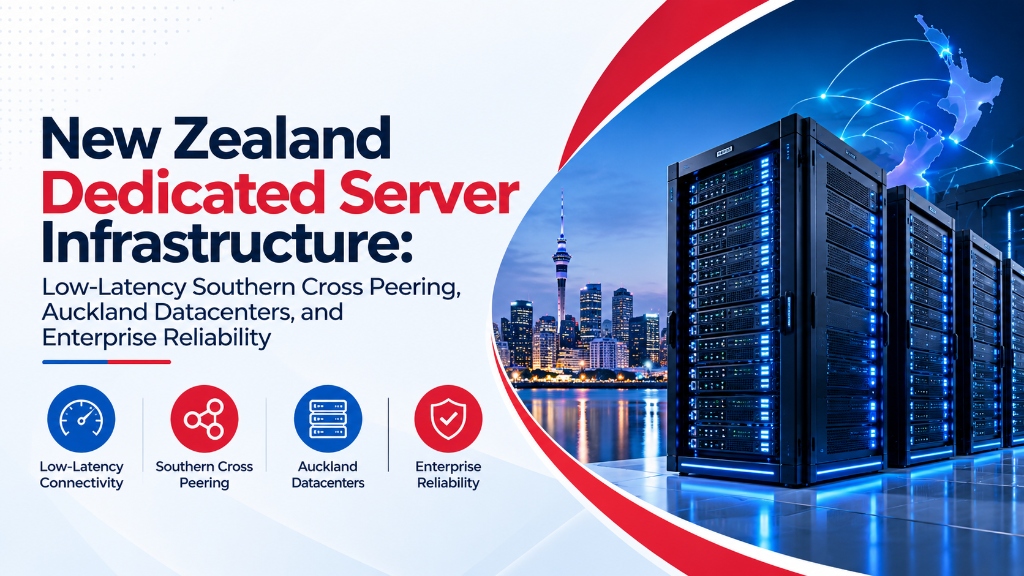
Deploying an enterprise Dedicated Server from Onlive Infotech delivers hardware-isolated computing resources, enterprise PCIe Gen4 NVMe storage arrays, and multi-gigabit Tier-1 network uplinks. It provides scalable performance, deterministic I/O throughput, and complete administrative control with 99.9% uptime SLA.
Explore our flexible VPS hosting plans for flexible virtualization.
- High-Throughput Compute: Physical core reservations with zero hypervisor contention guarantee predictable application performance.
- PCIe Gen4 NVMe Arrays: High-IOPS solid-state storage accelerates database queries, caching layers, and web application response times.
- Enterprise Network Uplinks: Redundant carrier feeds and automated DDoS filtering preserve service continuity under intense traffic spikes.
The digital economy of New Zealand and the wider Australasian region presents unique infrastructural opportunities and geographical requirements. Organizations serving Kiwi consumers, financial trading platforms, agricultural technology backends, and trans-Tasman enterprises require local computing power that eliminates trans-Pacific round-trip delays. Hosting critical business applications on servers located in North America, Europe, or East Asia introduces 130ms to 220ms round-trip latency, degrading user engagement, slowing database synchronization, and creating data sovereignty concerns under the New Zealand Privacy Act 2020. Deploying single-tenant bare-metal infrastructure through an enterprise dedicated server in premier Auckland data centers guarantees single-digit millisecond domestic latency, resilient subsea transit, and complete operational sovereignty. For mission-critical single-tenant workloads, deploy our high-availability cloud server infrastructure with unshared physical compute. For organizations scaling high-throughput compute workloads, our New Zealand dedicated server hosting infrastructure provides dedicated unmetered performance and enterprise hardware isolation.
Operating a dedicated bare-metal server in New Zealand completely eliminates the virtualization hypervisor layer. Your operating system kernel directly addresses physical processor execution pipelines, 12-channel DDR5 ECC memory buses, and PCIe Gen5 NVMe storage channels. For organizations outgrowing the resource limitations of entry-level VPS hosting or migrating from traditional web hosting configurations, dedicated server architecture provides the physical foundation necessary for continuous service availability and rigorous SLA adherence. When selecting a server administration interface, review our comprehensive Plesk vs cPanel control panel guide.
New Zealand Telecommunications Topography and Subsea Interconnects
New Zealand’s internet connectivity relies on high-capacity subsea fiber systems landing predominantly in the Auckland metropolitan area. Critical trans-oceanic cables include the Southern Cross Cable Network (connecting New Zealand to Sydney, Hawaii, and the US West Coast), Hawaiki Submarine Cable, and the Southern Cross NEXT system. These fiber routes deliver resilient multi-terabit bandwidth pathways to international internet exchange points.
Domestic traffic routing is anchored by the New Zealand Internet Exchange (NZIX), with primary peering points in Auckland and Christchurch. Connecting directly to NZIX exchange switches allows traffic between major domestic Internet Service Providers—including Spark, One NZ (Vodafone), 2degrees, and Chorus—to exchange packets locally within New Zealand without transiting international routes. Round-trip times within Auckland measure under 2 milliseconds, transit to Wellington registers below 8 milliseconds, and connections across the Cook Strait to Christchurch remain under 14 milliseconds. Trans-Tasman transit from Auckland to Sydney registers under 24 milliseconds.
High-volume network reliability is guaranteed through autonomous multi-homed BGP routing. By maintaining active BGP sessions across Tier-1 carriers—including Telstra, Spark, Lumen, and Vocus—the network automatically mitigates physical fiber cuts and upstream carrier outages. BGP route reflectors recalculate shortest Autonomous System paths within sub-second thresholds, preserving ongoing TCP socket connections without dropped packets.
Silicon Microarchitecture: Dual AMD EPYC 9004 vs. Intel Xeon Scalable
Modern bare-metal platforms deploy enterprise server processors engineered for intensive multi-threaded workloads, high cache capacities, and massive memory bandwidth. Depending on workload profiles, infrastructure engineers select between AMD EPYC 9004 series (Zen 4 microarchitecture, Genoa and Bergamo) and 4th/5th Generation Intel Xeon Scalable processors (Sapphire Rapids and Emerald Rapids).
Workloads characterized by intense parallel transaction processing—such as distributed microservices, multi-tenant databases, and queue workers—benefit significantly from AMD EPYC processors offering up to 128 physical cores and 256 execution threads per socket. Conversely, enterprise workloads requiring specialized hardware acceleration, such as Advanced Matrix Extensions (AMX) for neural inference or QuickAssist Technology (QAT) for line-rate cryptographic offloading, gain distinct performance advantages from Intel Xeon Scalable silicon.
Enterprise New Zealand Hardware Sizing Matrix
| Platform Tier | CPU Configuration | Memory Subsystem | Storage Architecture | Network Uplinks | Primary Workload Profile |
|---|---|---|---|---|---|
| Standard Enterprise | AMD EPYC 9354P (32C/64T @ 3.25GHz) | 128GB DDR5-4800 ECC | 2x 1.92TB PCIe Gen4 NVMe | 2x 10GbE LACP Bonded | E-Commerce Portals, Redis Caching |
| Database Intensive | Dual AMD EPYC 9554 (128C/256T @ 3.10GHz) | 512GB DDR5-4800 ECC | 4x 3.84TB U.2 Enterprise NVMe | 2x 25GbE Mellanox CX-6 | High-Concurrency PostgreSQL, MySQL |
| Enterprise Flagship | Dual AMD EPYC 9654 (192C/384T @ 2.40GHz) | 1,024GB DDR5-4800 ECC | 8x 3.84TB PCIe Gen5 NVMe | 2x 25GbE Redundant SFP28 | Bare-Metal Kubernetes, Big Data |
| FinTech Accelerator | Dual Intel Xeon Platinum 8480+ (112C/224T) | 512GB DDR5-4800 ECC | 4x 1.92TB PCIe Gen5 NVMe | 2x 25GbE Ultra-Low Latency | Algorithmic Execution, Quantitative Modeling |
Storage Subsystem Architecture: Direct-Attached PCIe Gen5 NVMe
Storage performance in modern bare-metal infrastructure is powered by Non-Volatile Memory Express (NVMe) solid-state storage communicating directly over dedicated PCIe lanes. Unlike legacy SATA solid-state drives constrained by legacy AHCI controllers (limited to 32 command queues with 1 command per queue), NVMe protocols support up to 64,000 independent queues with 64,000 commands per queue. This architectural leap enables sustained random I/O performance exceeding 1,200,000 IOPS per physical drive.
Enterprise U.2 and E3.S form-factor drives incorporate onboard Power Loss Protection (PLP) capacitors. In the event of an unexpected facility power failure, PLP circuitry supplies auxiliary power to flush in-flight DRAM write buffers to non-volatile NAND flash memory. This eliminates write-hole data corruption risks during high-frequency relational database transactions.
Benchmarking Storage IOPS and Tail Latency with FIO
Storage subsystem verification requires measuring random read/write throughput and 99th-percentile completion latencies under heavy queue depths:
When executed across enterprise PCIe Gen4 or Gen5 NVMe arrays, this benchmark verifies sequential bandwidth above 6,800 MB/s and random read latencies below 25 microseconds. This low-latency storage baseline prevents database query queuing and eliminates I/O bottlenecks during peak traffic periods.
Linux Kernel Tuning for High-Concurrency Platforms
Default Linux kernel networking parameters are optimized for low-resource environments. Tuning the network stack via `/etc/sysctl.d/99-network-tuning.conf` enables the kernel to sustain hundreds of thousands of concurrent connections:
Applying these parameters via `sudo sysctl -p /etc/sysctl.d/99-network-tuning.conf` prepares the system to manage sustained high-volume HTTP/3 and WebSocket traffic without dropping connection requests or exhausting socket memory buffers.
Data Sovereignty and New Zealand Privacy Act Compliance
Under the New Zealand Privacy Act 2020, organizations managing sensitive customer records, banking data, or agricultural supply chain telemetry must maintain rigorous governance over data locations. Deploying bare-metal hardware within certified Auckland data centers guarantees that sensitive personal information remains strictly within New Zealand legal jurisdiction, satisfying domestic regulatory criteria and audit requirements.
Disaster Recovery and Automated Data Replication: Auckland and Christchurch
Maintaining disaster recovery capabilities across New Zealand infrastructure demands automated, cryptographically secure data replication between North Island and South Island data centers. By utilizing OpenZFS native snapshotting and replication pipelines, multi-terabyte database systems replicate incremental block changes across a private trans-island network without performance disruption:
ZFS block-level transmission copies only modified disk blocks, minimizing transit bandwidth across the Cook Strait while ensuring that off-site backups remain byte-for-byte consistent with production storage.
Cross-Tasman Financial Latency Optimization to the ASX
Financial technology firms, algorithmic traders, and market data providers operating in New Zealand require ultra-low latency access to the Australian Securities Exchange (ASX) located in Sydney. High-capacity trans-Tasman fiber routes deliver sub-24ms round-trip latency between Auckland and Sydney:
Connecting directly to trans-Tasman carrier fabrics guarantees deterministic packet transit times without intermediate carrier throttling, enabling automated trading algorithms to execute orders at line rate.
Proactive Hardware Telemetry: IPMI 2.0 and Redfish Management
Remote infrastructure administration requires resilient out-of-band management. Every bare-metal chassis incorporates a Baseboard Management Controller (BMC) accessible over dedicated network ports, supporting IPMI 2.0 and DMTF Redfish standards:
This out-of-band management interface ensures continuous operational oversight. Engineers can remotely diagnose motherboard events, upgrade BIOS firmware, and mount recovery media without physical data center dispatch.
In addition to network peering benefits, deploying dedicated bare-metal servers in Auckland provides complete physical data isolation. Under modern enterprise security standards and the New Zealand Privacy Act 2020, organizations must verify the physical provenance and jurisdictional security of sensitive customer information. Bare-metal hosting guarantees that customer data, financial records, and proprietary databases remain exclusively stored on dedicated physical disks within New Zealand boundaries.
Operating a dedicated bare-metal server in Auckland eliminates unpredictable international transit charges and noisy neighbor performance degradation, providing your technical team with an agile foundation capable of sustaining millions of daily database queries and concurrent web transactions.
In addition, deploying an enterprise dedicated server gives your organization total control over kernel networking buffers, TCP socket backlog queues, and custom congestion control algorithms. By configuring Google BBR congestion control and Fair Queueing packet disciplines, your server delivers maximum line-rate throughput across trans-Tasman transit links with zero packet loss.
In addition, New Zealand bare-metal servers feature integrated Baseboard Management Controllers (BMC) supporting IPMI 2.0 and Redfish APIs. Administrators can monitor system temperatures, view serial console logs, cycle system power, and mount remote recovery media independently of operating system status.
Frequently Asked Questions
Q:
Why should an organization choose a New Zealand dedicated server over Australian hosting?
Q:
How does NZIX peering improve website loading speeds?
Q:
What is the operational purpose of Power Loss Protection (PLP) on enterprise NVMe drives?
Q:
How does 802.3ad LACP network bonding prevent infrastructure downtime?
Q:
What out-of-band management capabilities are provided with bare-metal servers?
Infrastructure Decision Framework: Choosing Your Deployment
Balancing low latency transit, dedicated hardware isolation, and predictable operating costs ensures long-term performance stability for enterprise applications.
Deploy high-performance enterprise dedicated server solutions equipped with enterprise NVMe storage arrays, redundant network uplinks, and 24/7 expert engineering support from Onlive Infotech.
For streamlined domain management and server configuration across multi-tenant environments, refer to our comprehensive Plesk vs cPanel hosting control panel guide.
•

✓
