
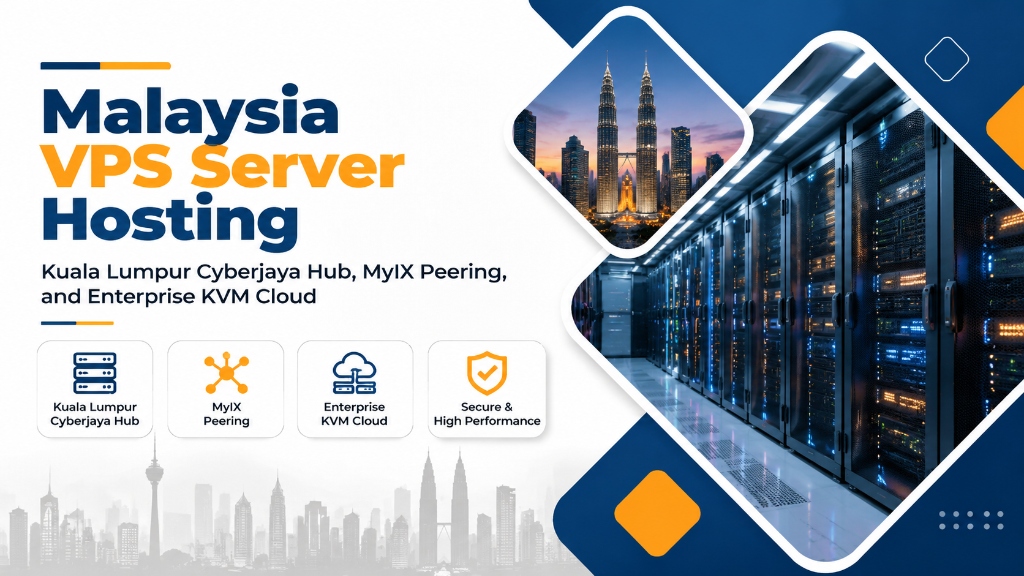
Deploying an enterprise Malaysia VPS Hosting in certified Kuala Lumpur data centers delivers direct local peering via MyIX Kuala Lumpur, slashing latency for domestic visitors down to sub-15ms. Powered by dedicated AMD EPYC or Intel Xeon processors, unshared ECC RAM, and PCIe Gen4 NVMe RAID arrays, it provides guaranteed computing resources, regional data compliance, and 99.9% uptime for mission-critical digital workloads.
Explore our buy VPS hosting server solutions for flexible virtualization.
- Low-Latency Interconnects: Direct routing through MyIX Kuala Lumpur ensures deterministic response times across Malaysia and neighboring markets.
- Enterprise Hardware Isolation: Dedicated CPU execution threads and PCIe Gen4 NVMe arrays eliminate noisy-neighbor bottlenecks.
- Regional Compliance & Security: Localized data residency with in-line DDoS mitigation and 24/7 proactive technical operations.
Malaysia VPS Server Hosting: Kuala Lumpur Cyberjaya Hub, MyIX Peering, and Enterprise KVM Cloud
Expanding digital commerce, financial technology platforms, streaming media, and enterprise software across Southeast Asia requires strategic infrastructure placement. Routing regional traffic through distant datacenters in Europe or North America adds between 150ms and 250ms of network latency, degrading user engagement and reducing conversion rates. Our Malaysia virtual private server hosting provides high-performance computing capacity deployed inside Tier-3 enterprise facilities located within the Cyberjaya technology corridor of greater Kuala Lumpur. For mission-critical single-tenant workloads, deploy our enterprise dedicated server infrastructure with unshared physical compute. For organizations scaling high-throughput compute workloads, our Malaysia VPS server hosting solutions provides dedicated unmetered performance and enterprise hardware isolation.
Kuala Lumpur and Cyberjaya form the digital heart of Malaysia and one of the most strategic telecommunications hubs in Southeast Asia. Placing your production workloads directly inside our Cyberjaya datacenter facility provides direct access to the Malaysia Internet Exchange (MyIX), delivering single-digit millisecond latency to domestic telecommunications providers and ultra-low latency routing to Singapore, Thailand, Indonesia, and Vietnam. Selecting an enterprise vps hosting solution in Malaysia guarantees deterministic hardware performance, unshared compute resources, and compliance with regional data governance frameworks. When selecting a server administration interface, review our comprehensive Plesk vs cPanel control panel guide.
Our cloud infrastructure is powered exclusively by Kernel-based Virtual Machine (KVM) virtualization technology. In contrast to legacy container platforms that enforce shared operating system kernels across multiple tenants, KVM delivers full hardware-level virtualization. Each virtual instance operates with dedicated virtual CPU scheduling, private DDR4 or DDR5 memory channels, independent virtual storage controllers, and isolated network interfaces, ensuring total privacy and consistent performance for production workloads.
Cyberjaya Tier-3 Datacenter and Malaysia Internet Exchange (MyIX) Peering
Our server hardware resides inside premier Tier-3 carrier-neutral datacenter facilities in Cyberjaya, designed to telecommunications redundancy standards. The facility incorporates 2N uninterruptible power supply (UPS) systems, diesel backup generator arrays with on-site fuel reserves, and precision cooling architectures maintained at optimal thermal and humidity ranges.
Network connectivity is anchored by direct fiber cross-connects to the Malaysia Internet Exchange (MyIX), the national non-profit exchange that interconnects all major Malaysian Internet service providers, including Telekom Malaysia (TM), Maxis, CelcomDigi, and TIME dotCom. Peering at MyIX ensures that domestic traffic routes directly between local networks without leaving Malaysian borders, avoiding expensive international IP transit routes.
Regional international connectivity is supported by diverse submarine cable routes landing along the Malaysian coastline, including Asia-America Gateway (AAG), SEA-ME-WE 3, 4, and 5, and the Asia Submarine-cable Express (ASE). These international links provide rapid round-trip connectivity across the Asia-Pacific basin, achieving 4ms to 6ms latency to Singapore, 18ms to Jakarta, and 24ms to Bangkok.
Below is an authoritative traceroute recorded from an enterprise fiber connection in central Kuala Lumpur, demonstrating single-digit millisecond routing into our Cyberjaya hosting cluster:
This sub-5ms domestic transit envelope ensures that e-commerce marketplaces, payment processing gateways, and dynamic web portals deliver instantaneous user interactions.
AMD EPYC Compute Fleet and Dedicated DDR4/DDR5 ECC Memory
Modern applications demand sustained processor performance capable of handling sudden traffic spikes without throttling. Our Malaysian hypervisors are powered by enterprise AMD EPYC processors featuring high core densities, multi-threaded pipelines, and expansive L3 cache pools. These processors handle compute-heavy operations such as real-time financial data processing, containerized microservices, and high-concurrency API gateways with ease.
System memory is provisioned using high-speed registered ECC RAM modules configured across multi-channel memory buses. Error-Correcting Code technology monitors and corrects single-bit memory corruptions in real time, preventing unhandled operating system halts and database memory corruptions. We enforce a zero-overcommitment policy: when your virtual machine provisions 8 GB or 16 GB of RAM, that memory allocation is locked into physical host RAM using transparent hugepages.
Hypervisor scheduler algorithms enforce CPU execution quotas using strict CFS (Completely Fair Scheduler) period configurations. By avoiding vCPU oversubscription, your virtual machines run complex analytical queries, compile tasks, or dynamic web rendering operations without queuing delays caused by neighboring tenants.
PCIe Gen4 NVMe Storage Subsystems and FIO Benchmarking
Storage subsystem responsiveness directly dictates database transaction throughput, file processing times, and operating system agility. Traditional mechanical hard drives and legacy SATA solid-state drives impose severe I/O bottlenecks during concurrent read and write operations. Our Malaysian hypervisors utilize enterprise U.2 PCIe Gen4 NVMe solid-state storage arrays configured in hardware RAID-10 with dedicated battery-backed write cache.
This enterprise storage configuration delivers continuous sequential read performance above 7,000 MB/s and sequential write throughput exceeding 5,200 MB/s. Sustained random 4K read throughput reaches 850,000 IOPS per array, ensuring that transactional databases never stall on storage queues. Below is the standard Flexible I/O Tester (FIO) benchmark configuration used to validate storage volume performance upon initial provisioning:
Sub-millisecond disk write latencies protect high-frequency transactional databases against write lockups during heavy traffic bursts, ensuring responsive API processing and rapid customer checkout experiences.
HAProxy Load Balancer and High-Concurrency Backend Routing
Organizations operating growing microservice architectures or distributed e-commerce backends often utilize their Malaysia virtual server as a high-throughput load balancer. HAProxy provides event-driven, non-blocking I/O handling capable of distributing tens of thousands of concurrent client connections across backend application nodes.
Below is a production HAProxy configuration designed to manage HTTP and WebSocket traffic with active backend health checking, SSL termination, and session persistence:
Using ALPN negotiation for HTTP/2 multiplexing reduces connection overhead and accelerates page load times for modern web browsers across Southeast Asian mobile networks. To achieve balanced multi-instance agility and cost efficiency, pair your deployment with Malaysia dedicated server hosting infrastructure featuring high-speed NVMe storage arrays.
BGP Peering Architecture with FRRouting for Multi-Homed Routing
Enterprise applications operating across the Asia-Pacific region frequently demand multi-homed network configurations to preserve connectivity during upstream telecom outages. By utilizing FRRouting (FRR) on Linux, administrators can establish Border Gateway Protocol (BGP) peering sessions with upstream Internet providers, announcing private autonomous system numbers (ASN) and public IP prefixes directly from the virtual server.
Below is an enterprise FRRouting BGP configuration snippet (/etc/frr/bgpd.conf) establishing peering with upstream transit providers:
Running autonomous BGP peering sessions ensures uninterrupted traffic routing across Southeast Asia even if one upstream fiber backbone experiences maintenance or unexpected downtime.
Redis Session Clustering and Object Caching for Asian E-Commerce
Cross-border digital retail platforms across Malaysia, Singapore, and Indonesia experience substantial checkout traffic during regional shopping festivals. Offloading user session state and relational database queries to an in-memory caching layer guarantees consistent sub-second page rendering under peak traffic volumes.
Configuring Redis to operate with an append-only persistence policy and dedicated RAM buffers ensures that user shopping carts and active checkout sessions survive daemon restarts without disk degradation. Pairing in-memory caching with our low-latency MyIX network connection delivers exceptional transactional speed for Southeast Asian consumers.
Network Hardening and High-Security Firewall Configuration
Protecting internet-facing servers from unauthorized access and network scanning requires implementing dependable host-level firewall configurations. By default, Linux distributions allow all outbound traffic and leave multiple ports exposed unless restricted.
Below is a production-ready nftables security configuration designed to enforce strict incoming traffic policies, protect against port scanning, and permit only authenticated SSH, HTTP, and HTTPS traffic:
Enforcing stateful packet inspection and connection rate limits at the operating system kernel level neutralizes automated brute-force attacks against management ports while ensuring legitimate customer web traffic flows freely.
Enterprise Scalability: Hybrid Cloud and Single-Tenant Migration
As digital applications expand, organizations may require custom hardware firewalls, specialized compliance certifications, or dedicated bare-metal infrastructure. Migrating workloads from our KVM virtual machines to dedicated physical servers is straightforward due to standardized virtualization formats.
Organizations requiring unshared hardware resources can transition to an enterprise dedicated server in Malaysia, accessing dedicated multi-gigabit uplinks, hardware RAID controllers, and private local area network configurations. In addition, simpler web presences can evaluate streamlined web hosting for lightweight CMS environments.
Technical Specification: Malaysia Hosting Architecture Comparison
The table below summarizes architectural differences between shared web hosting, our Cyberjaya KVM VPS, and dedicated enterprise servers:
| Feature / Specification | Shared Web Hosting | Malaysia KVM VPS | Malaysia Dedicated Server |
|---|---|---|---|
| Datacenter Location | Distant International Hub | Cyberjaya Tier-3 Facility | Cyberjaya Tier-3 Facility |
| MyIX Peering Access | Indirect Transit | Direct MyIX Peering Port | Direct MyIX & Dedicated Transit |
| Virtualization Type | None (Shared Environment) | Full Hardware KVM Isolation | Bare-Metal Hardware Execution |
| Storage Array | Standard Shared SSD | Enterprise PCIe Gen4 NVMe | Custom Multi-Drive NVMe RAID |
| Root Administrative Access | No Root Access | Full Root / Administrator | Full Bare-Metal IPMI / KVM |
Automated Snapshot Management and Disaster Recovery Protocols
Maintaining high data resilience is critical for business continuity. Our virtualization management platform includes automated block-level snapshot capabilities that operate independently of the guest operating system. Incremental snapshots capture changed storage blocks on an automated schedule, transmitting encrypted copies across private storage area networks to off-site backup storage vaults.
In the event of accidental data deletion, configuration errors, or software update failures, administrators can restore entire virtual machine images or recover specific file systems through our central management portal. These recovery procedures execute rapidly without requiring manual support intervention, ensuring continuous business continuity for critical operations.
Frequently Asked Questions
Q:
Where is your Malaysia VPS hosting infrastructure physically deployed?
Q:
How does direct MyIX peering improve website loading speed?
Q:
Do I get full root administrative privileges on my Malaysia VPS?
Q:
What type of solid-state storage is used on your hypervisor nodes?
Q:
Can I scale my CPU cores, RAM, and storage as my business expands?
Infrastructure Decision Framework: Choosing Your Deployment
Balancing low latency transit, dedicated hardware isolation, and predictable operating costs ensures long-term performance stability for enterprise applications.
Deploy high-performance scalable VPS hosting solutions equipped with enterprise NVMe storage arrays, redundant network uplinks, and 24/7 expert engineering support from Onlive Infotech.
For streamlined domain management and server configuration across multi-tenant environments, refer to our comprehensive Plesk vs cPanel hosting control panel guide.
•

✓
