
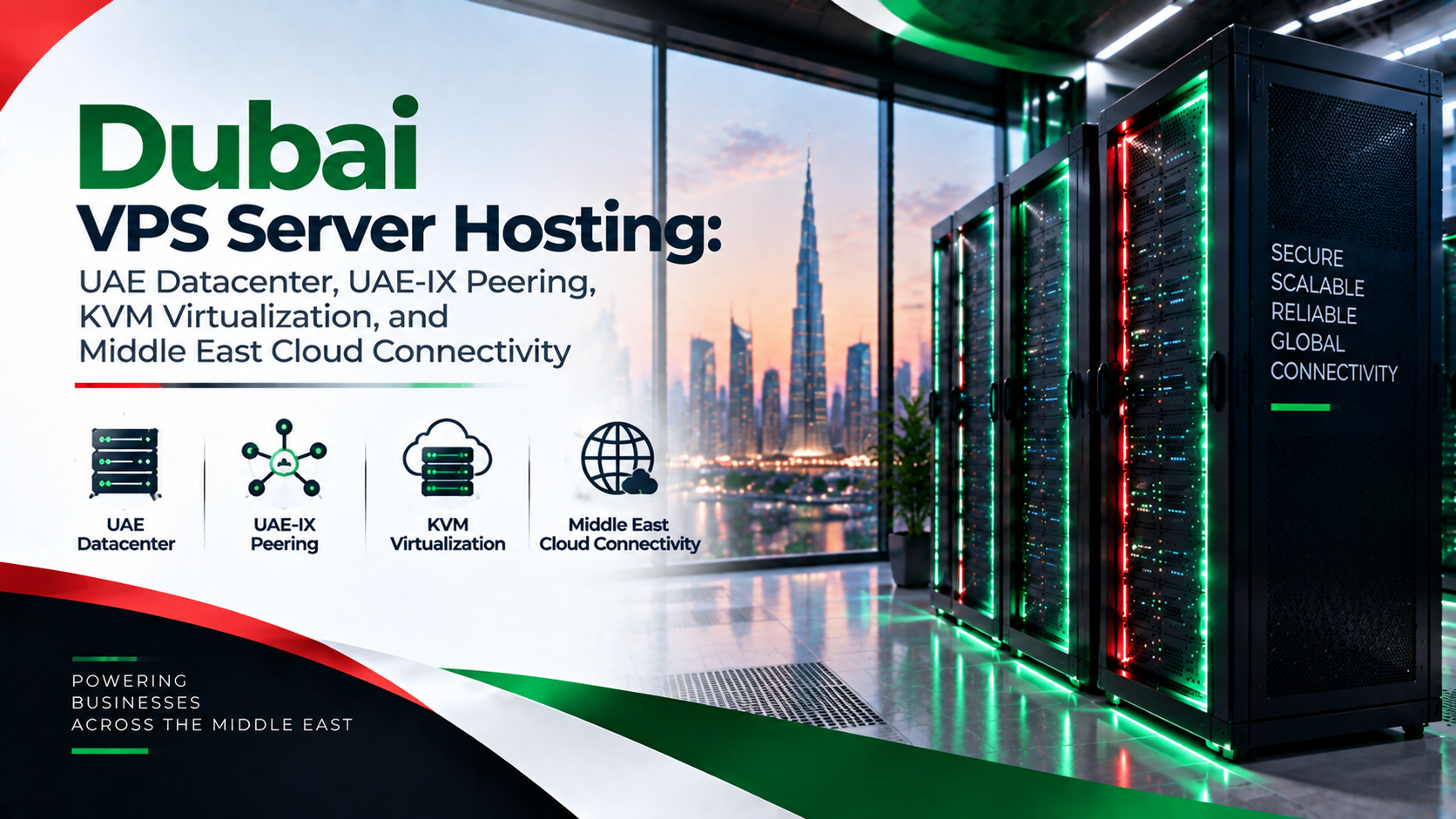
Deploying an enterprise VPS Hosting from Onlive Infotech delivers hardware-isolated computing resources, enterprise PCIe Gen4 NVMe storage arrays, and multi-gigabit Tier-1 network uplinks. It provides scalable performance, deterministic I/O throughput, and complete administrative control with 99.9% uptime SLA.
Explore our buy VPS hosting server solutions for flexible virtualization.
- High-Throughput Compute: Physical core reservations with zero hypervisor contention guarantee predictable application performance.
- PCIe Gen4 NVMe Arrays: High-IOPS solid-state storage accelerates database queries, caching layers, and web application response times.
- Enterprise Network Uplinks: Redundant carrier feeds and automated DDoS filtering preserve service continuity under intense traffic spikes.
Dubai VPS Server Hosting: Enterprise Cloud Infrastructure for Middle Eastern Operations
Modern enterprises executing digital operations across the United Arab Emirates, Saudi Arabia, Qatar, Kuwait, Oman, and the wider Gulf Cooperation Council region require high-performance hosting located within regional borders. Hosting services outside the Middle East introduces transatlantic or trans-Eurasian network latency exceeding 130 milliseconds, creating noticeable latency for local users and complicating data sovereignty compliance. Our Dubai virtual private servers provide local enterprise compute located in Tier-3 carrier-neutral facilities. For mission-critical single-tenant workloads, deploy our enterprise dedicated server infrastructure with unshared physical compute. For organizations scaling high-throughput compute workloads, our Dubai VPS server hosting solutions provides dedicated unmetered performance and enterprise hardware isolation.
Establishing digital platforms inside the UAE delivers immediate competitive advantages for financial services, retail applications, government contractors, logistics platforms, and enterprise portals. By positioning workloads inside Dubai datacenters directly connected to the UAE Internet Exchange (UAE-IX), domestic latency drops below 6 milliseconds across Dubai and Abu Dhabi. Selecting a reliable vps hosting platform provides the flexibility of cloud scaling with the deterministic performance of physical bare-metal hardware. When selecting a server administration interface, review our comprehensive Plesk vs cPanel control panel guide.
Virtualization isolation remains paramount for security-conscious organizations. Unlike containerized environments that share a common host kernel, our Dubai KVM virtualization delivers full hardware abstraction, dedicated RAM address spaces, private virtual CPU scheduling, and independent block storage buses. Each virtual instance operates as an isolated virtual appliance, offering complete stability for mission-critical software.
AMD EPYC Processing Power and Unshared DDR5 ECC Memory
Modern corporate workloads demand consistent compute cycles capable of sustaining high transactional throughput during business peak hours. Our Dubai hypervisors are powered by dual-socket AMD EPYC 9004 series processors operating at sustained clock speeds up to 3.8 GHz. These compute engines deliver high IPC (instructions per cycle) performance, hardware-enforced AES-NI cryptographic acceleration, and virtualization extension flags (AMD-V) passed directly to guest operating systems.
Memory allocations utilize 4800 MHz DDR5 registered ECC modules configured across multi-channel memory buses. ECC technology constantly scans for and corrects transient memory errors, eliminating unexpected system halts during memory-intensive processing cycles. We implement a strict anti-overcommit provisioning model. If your Dubai instance reserves 16 GB of memory, that entire memory footprint remains reserved in physical host RAM.
Hypervisor scheduler algorithms enforce CPU execution quotas using strict CFS (Completely Fair Scheduler) period configurations. By avoiding vCPU oversubscription, your virtual machines run complex analytical queries, compile tasks, or dynamic web rendering operations without queuing delays caused by neighboring tenants.
Enterprise PCIe Gen4 NVMe RAID-10 Storage Arrays
I/O bottlenecks severely restrict application scaling and transactional reliability. Traditional SATA SSDs throttle throughput at 550 MB/s, causing database read queries and disk-intensive file operations to stall. Our Dubai storage infrastructure utilizes direct-attached enterprise PCIe Gen4 NVMe solid-state drives configured in hardware RAID-10 arrays backed by non-volatile write cache controllers.
This storage architecture easily achieves sequential read speeds in excess of 6,800 MB/s and write speeds reaching 5,100 MB/s. Sustained random 4K I/O operations achieve over 750,000 IOPS per host array, ensuring that database read-write cycles, indexing runs, and logging processes execute without disk wait delays. Here is the output from a standard Flexible I/O Tester benchmark executed against a newly provisioned Dubai volume:
Low latency storage access guarantees responsive database performance for relational systems such as MySQL, MariaDB, and PostgreSQL, as well as fast index traversal for Elasticsearch and OpenSearch clusters.
Dubai Network Interconnects, Datamena, and UAE-IX Peering
Strategic geographic positioning makes Dubai the dominant telecommunication gateway for the Middle East. Our server nodes are housed within premier Tier-3 facilities including Equinix DX1 and Datamena in Dubai. These facilities provide direct interconnects to the UAE Internet Exchange (UAE-IX), connecting our network fabric directly to domestic ISPs including Etisalat (e&) and du.
Local peering agreements ensure that domestic and Gulf regional traffic bypasses long-distance transit cables, dropping round-trip response times to negligible levels. For international transit, our redundant BGP routing mesh connects to Tier-1 international carriers including Lumen, Tata Communications, Telecom Italia Sparkle, and Oteglobe. Redundant 40 Gbps and 100 Gbps uplinks with automatic subsea route failover ensure continuous connectivity even during submarine cable maintenance events in the Red Sea or Arabian Gulf.
| Destination Hub | Routing Fabric / Exchange | Average Round-Trip Latency | Network Availability SLA |
|---|---|---|---|
| Dubai Domestic | UAE-IX / Local Metro Peering | 1.8 – 4.2 ms | 99.99% |
| Abu Dhabi, UAE | Direct Terrestrial Interconnect | 3.8 – 6.5 ms | 99.99% |
| Riyadh, Saudi Arabia | Cross-Border Terrestrial Fiber | 14.5 – 18.2 ms | 99.95% |
| Doha, Qatar | Gulf Subsea Ring | 12.1 – 15.4 ms | 99.95% |
| Kuwait City, Kuwait | Zain / Ooredoo Terrestrial | 19.8 – 24.1 ms | 99.95% |
| Mumbai, India | Direct Arabian Sea Subsea Cable | 28.5 – 32.8 ms | 99.95% |
Operating System Tuning and High-Throughput Network Optimization
Maximizing network throughput on modern high-speed virtual interfaces requires precise kernel optimization. Stock Linux installations enforce conservative buffer allocations designed for lightweight desktop devices. Systems administrators should apply optimized kernel parameters via `/etc/sysctl.conf` to support thousands of concurrent client connections without connection dropping:
Enabling Google’s BBR congestion control algorithm enables your server to detect available network path capacity dynamically, maximizing data transfer rates across regional and international connections while preventing TCP throughput collapse during momentary buffer congestion.
Production Database Optimization and Memory Buffer Pool Tuning
Relational database management systems like PostgreSQL and MySQL InnoDB represent the core computational workload for most enterprise web applications in the Middle East. Because NVMe storage arrays provide rapid access times, tuning database configuration parameters to match hardware limits unlocks significant performance gains. Below are key parameters for optimizing PostgreSQL on our Dubai VPS instances:
Configuring a low random_page_cost value of 1.1 instructs the database query planner that reading non-contiguous data blocks incurs virtually no mechanical seek penalty on NVMe storage. As a result, the optimizer favors index scans over expensive sequential table scans, reducing CPU cycles and accelerating complex analytical queries.
Infrastructure Observability, Prometheus Exporters, and Systemd Isolation
Maintaining high service availability requires continuous visibility into virtual machine telemetry. Every production server should deploy lightweight Prometheus node exporters running under systemd with strict cgroup resource constraints. This configuration prevents monitoring agents from consuming excessive compute resources while delivering metrics to central dashboards:
By defining explicit memory ceilings and CPU quotas in systemd service definitions, administrators ensure that unexpected memory leaks inside background services are killed before they endanger critical web or database processes.
Hardware Profiles and Resource Specifications
We provide a comprehensive range of pre-configured virtual machine tiers engineered to support diverse deployment requirements, ranging from lightweight application gateways to high-volume database backends. Review the hardware allocation matrix below:
| Instance Tier | vCPU Cores | DDR5 ECC RAM | PCIe NVMe Storage | Network Uplink |
|---|---|---|---|---|
| DXB-Standard-01 | 2 vCPUs (Dedicated) | 4 GB DDR5 | 60 GB NVMe RAID-10 | 1 Gbps Port / 4 TB Transfer |
| DXB-Business-02 | 4 vCPUs (Dedicated) | 8 GB DDR5 | 120 GB NVMe RAID-10 | 1 Gbps Port / 8 TB Transfer |
| DXB-Enterprise-03 | 8 vCPUs (Dedicated) | 16 GB DDR5 | 240 GB NVMe RAID-10 | 1 Gbps Port / 12 TB Transfer |
| DXB-HighDensity-04 | 16 vCPUs (Dedicated) | 32 GB DDR5 | 480 GB NVMe RAID-10 | 2.5 Gbps Port / 20 TB Transfer |
For organizations requiring unshared physical compute clusters or regulatory compliance mandates demanding physical separation, we provide custom hybrid architectures linking private cloud instances directly to an unshared dedicated server infrastructure inside the same Dubai datacenter suite.
Security Hardening and Edge DDoS Protection
Protecting internet-facing assets against unauthorized access, port scans, and distributed denial-of-service attempts requires layered defense-in-depth security. In addition to upstream datacenter scrubbing filters, every instance must be secured with kernel-level packet inspection. Here is a recommended production `nftables` ruleset for securing your Dubai server:
Upstream hardware scrubbing platforms continually monitor traffic patterns, automatically mitigating volumetric floods such as NTP amplification, UDP floods, and SYN floods up to 1.2 Tbps before malicious traffic can reach your virtual network interface.
Control Portal, Out-of-Band Console, and Operating Systems
Managing your virtual infrastructure is simple and intuitive through our self-service control panel. Administrators can perform soft reboots, hard power cycles, ISO mounts, and volume resizing with immediate execution. When administrative network firewall errors or misconfigured SSH daemon settings lock you out of remote access, the integrated HTML5 noVNC console provides emergency out-of-band keyboard and monitor access directly to the virtual machine.
Supported operating system templates include Ubuntu 22.04 LTS, Ubuntu 24.04 LTS, Debian 12, AlmaLinux 9, Rocky Linux 9, and Windows Server 2022. You can also mount custom operating system ISO images directly from remote URLs to install customized distributions or hardened corporate images.
For unified web management across multiple projects, our instances integrate cleanly alongside standard web hosting environments, providing stable infrastructure consolidation.
BGP Dynamic Routing, Autonomous System Peering, and Multi-Homed Connectivity
Production availability across the Gulf Cooperation Council requires active multi-homed BGP routing. Our Dubai infrastructure connects via dual upstream transit carriers utilizing dynamic Border Gateway Protocol (BGP4) routing. By advertising customer IP prefixes across autonomous system numbers with multi-exit discriminator path metrics, traffic instantly diverts to alternate fiber routes during upstream maintenance windows. This dynamic rerouting maintains continuous uptime for transactional banking, commerce, and media applications without manual intervention.
Frequently Asked Questions
Q:
Why should my business choose a VPS hosted physically in Dubai?
Q:
How does KVM virtualization maintain server performance stability?
Q:
Do I receive full root or administrative access to the server?
Q:
What automated backup and snapshot solutions are available?
Q:
Can I upgrade my server resources as my application traffic grows?
Infrastructure Decision Framework: Choosing Your Deployment
Balancing low latency transit, dedicated hardware isolation, and predictable operating costs ensures long-term performance stability for enterprise applications.
Deploy high-performance scalable VPS hosting solutions equipped with enterprise NVMe storage arrays, redundant network uplinks, and 24/7 expert engineering support from Onlive Infotech.
For streamlined domain management and server configuration across multi-tenant environments, refer to our comprehensive Plesk vs cPanel hosting control panel guide.
•

✓
